For researchers, professors, PhD scholars, teachers, and other academic professionals, learning how to turn your research paper or thesis into a book can be an effective way to share years of research with a wider audience. A thesis or research paper contains valuable knowledge, findings, arguments, and ideas that can potentially be developed into a professionally published book.
However, turning a thesis into a book is not simply a matter of changing the cover or uploading the existing document. A thesis is generally written to meet academic or institutional requirements, while a book needs to provide a clear, engaging, and reader-focused experience.
The process may involve restructuring chapters, identifying the target audience, updating research, simplifying technical writing, editing and proofreading, designing the book, obtaining an ISBN, selecting a publishing model, distributing the book, and promoting it.
Can You Turn Your Thesis or Dissertation Into a Book?
Yes, it is possible to turn a thesis or dissertation into a book, provided that the material can be appropriately adapted and you have the necessary rights to publish the content.
A thesis and a book have different purposes. A thesis is generally prepared for an academic institution and demonstrates research capability. It may contain an extensive literature review, detailed methodology, research questions, data, references, appendices, and other institutional requirements.
An academic book, on the other hand, needs to communicate the significance of the research to its intended readers in a clear and cohesive way.
Before converting your thesis into a book, consider the following questions:
- Who will read the book?
- What is the central argument or theme?
- Which sections are essential?
- Which academic sections can be shortened?
- What new material should be added?
- What level of technical detail is appropriate?
- Are the citations and references properly formatted?
The goal is not necessarily to publish the thesis exactly as it was submitted. The goal is to transform the valuable research into a book that readers can understand, use, and engage with.
Thesis vs Academic Book: What's the Difference?
Understanding the difference between a thesis and an academic book is an important first step when converting research into a publication.
| Feature | Thesis/Dissertation | Academic Book |
|---|---|---|
| Primary Purpose | Academic evaluation | Sharing knowledge with readers |
| Target Audience | Supervisors, examiners, and academic institutions | Researchers, students, professionals, and other readers |
| Structure | Institutional or academic format | Reader-focused chapter structure |
| Writing Style | Formal and technical | Academic but more accessible |
| Literature Review | Often extensive | Usually integrated into the overall argument |
| Methodology | Detailed | Included according to relevance |
| References | Extensive | Selective and relevant |
| Appendices | Often included | Included when useful to readers |
| Length | Based on institutional requirements | Depends on subject and target audience |
| Design | Academic submission format | Professionally designed book |
A thesis demonstrates your research work, while a book presents the value of that research to a wider readership. This is why simply uploading a thesis and calling it a book may not provide the best publishing outcome.
Why Turn Your Thesis Into a Book?
Researchers can spend years developing a thesis or dissertation. Converting that research into a book can provide another way to make the knowledge available beyond the university or institution where the research was originally submitted.
1. Reach a Wider Audience
A thesis may primarily be available through a university library, academic repository, or research database. A published book can potentially reach researchers, students, teachers, professionals, libraries, and general readers interested in the subject.
2. Establish Academic Authority
A well-researched academic book can help an author present their expertise and research to a broader professional and academic audience. It can become a useful resource for scholars, teachers, consultants, and subject-matter specialists.
3. Preserve Your Research
Research represents a significant investment of time and intellectual effort. Publishing the work as a book can create a lasting resource that readers can access beyond the original academic submission.
4. Support Students and Researchers
An academic book can provide students and researchers with background information, case studies, research findings, methodologies, and other relevant material related to the subject.
5. Create New Professional Opportunities
A published academic book may also support opportunities such as:
- Academic collaborations
- Speaking engagements
- Teaching opportunities
- Research partnerships
- Conferences and seminars
- Professional consulting
- Media and expert interviews
Step 1: Evaluate Your Thesis and Develop It Into a Book
Before rewriting your thesis, read it from the perspective of a future reader rather than as the author of an academic submission.
Ask yourself:
- What is the main point of my research?
- What problem does the research address?
- Who would benefit from reading this book?
- Which findings are most important?
- Is the research still relevant?
- Which chapters can be removed or combined?
- What information needs to be updated?
- Can someone outside my academic institution understand the research?
This assessment can help you determine whether your thesis needs minor restructuring or a substantial rewrite. A well-researched thesis can provide strong material for a book, but it may still require significant revision for readability and reader engagement.
Step 2: Identify Your Target Audience
A thesis is usually written for supervisors, examiners, and an academic institution. A book needs to be written for a defined readership.
Your potential audience could include:
- University students
- Researchers
- Professors and teachers
- Industry professionals
- Policymakers
- Subject-matter experts
- General readers interested in the topic
- Professionals working in a specific field
For example, research on artificial intelligence in healthcare could be developed differently depending on whether the intended readers are researchers, healthcare professionals, students, policymakers, or general readers.
Your target audience can influence the book's language, structure, examples, technical depth, and presentation.
Step 3: Find the Main Idea of Your Research
A thesis may contain multiple research questions, hypotheses, methodologies, results, and discussions. A book generally benefits from a more cohesive central idea.
Ask yourself:
What is the one major idea I want readers to take away from this book?
The central idea could be:
- A new research finding
- A theoretical argument
- A new methodology
- A historical analysis
- A social issue
- A scientific discovery
- A practical framework
- A case study
- A new interpretation of an existing subject
Once you identify the central idea, review every chapter and section to determine whether it supports that idea. Information that does not contribute meaningfully to the book may need to be removed, shortened, or moved to supporting material.
A clearly defined central argument can make an academic book easier to understand and more useful to its intended audience.
Step 4: Transform Your Thesis Structure Into a Book Structure
One of the most important stages in converting a thesis into a book is restructuring the manuscript.
A typical thesis may follow a structure such as:
- Introduction
- Literature Review
- Research Methodology
- Results
- Discussion
- Conclusion
- References
- Appendices
A book may require a different structure based on the topic and intended readership. For example:
Chapter 1: Introduction
Introduce the subject, establish its importance, and explain the central question or argument.
Chapter 2: Background and Context
Provide the historical, theoretical, scientific, or practical background readers need to understand the subject.
Chapter 3: Existing Research
Instead of reproducing the entire literature review, present the most relevant research and connect it to the central argument.
Chapter 4: Research Approach
Explain the methodology clearly and concisely so readers understand how the research was conducted without unnecessary academic detail.
Chapter 5: Key Findings
Present the most important findings using relevant examples, tables, charts, or case studies where appropriate.
Chapter 6: Analysis and Discussion
Interpret the findings and explain their significance and possible applications.
Chapter 7: Applications and Implications
Explain how the research may be relevant to academia, industry, education, policy, or other areas.
Chapter 8: Conclusion
Summarize the main ideas and reinforce the reader's understanding of the research.
The final organization should depend on the topic, research type, audience, and publishing objectives. Instead of forcing the thesis structure into the book, build the structure around the path your readers need to follow.
Step 5: Rewrite the Literature Review
The literature review is often one of the sections that requires significant restructuring. In a thesis, a detailed literature review can demonstrate knowledge of previous research and establish the academic background of the study.
For a book, however, a lengthy literature review may make the reading experience difficult. Consider:
- Keeping the most relevant research
- Removing repetitive discussions
- Combining related studies
- Updating outdated references
- Explaining important academic debates
- Connecting previous research to the central argument
- Using research to support the discussion rather than overwhelming it
The objective is to help readers understand how knowledge has developed in the field rather than simply reproducing the literature review submitted to an institution.
Step 6: Update Your Research and References
Research can become outdated, particularly in rapidly changing fields. Before publishing your thesis as a book, review the manuscript for developments that may have occurred since the original research was completed.
Review:
- Recent research papers
- New theories
- Updated statistics
- Recent case studies
- Changes in regulations or policies
- New technologies
- Recent developments in your field
- New academic debates
This can be particularly important for subjects such as technology, medicine, economics, education, law, business, and social sciences.
Review your references and bibliography as well. Remove irrelevant references, correct formatting issues, and include recent relevant sources where appropriate.
Step 7: Convert Academic Writing Into Reader-Friendly Text
Theses are often formal and technical because they are written for an academic audience. An academic book can maintain scholarly credibility while using language that is easier for its intended readers to follow.
Consider adding:
- Real-world examples
- Case studies
- Practical applications
- Illustrations
- Tables
- Diagrams
- Explanatory notes
- Relevant examples from industry or current developments
Long and highly technical sentences can often be rewritten into shorter, clearer paragraphs without removing the academic substance.
The objective is not to remove academic credibility. Instead, the aim is to make the research more accessible and useful to the intended audience.
Step 8: Decide What to Remove From Your Thesis
Not everything included in a thesis necessarily needs to appear in the final book. Depending on the subject and publishing purpose, you may need to remove or shorten:
- University submission declarations
- Approval pages
- Institutional acknowledgements
- Excessively detailed literature reviews
- Repetitive explanations
- Research administration details
- Raw information that does not support the main argument
- Redundant appendices
- Repeated methodology explanations
Some information may instead be retained as notes, appendices, supplementary material, or supporting information.
The goal is to keep the research that readers need rather than everything that was required for academic assessment.
Step 9: Check Copyright and Publication Rights
Before publishing your thesis as a book, check whether you have the necessary rights to use all the material included in the manuscript.
This is particularly important if your thesis contains:
- Previously published journal articles
- Copyrighted images
- Photographs
- Charts or figures created by others
- Third-party datasets
- Long quotations
- Licensed research material
- Material created as part of a funded project
If portions of your thesis have already been published elsewhere, review the relevant publishing agreements to determine whether you can reuse that material in a book.
When necessary, obtain appropriate permission or professional guidance before publication. Resolving copyright and licensing issues before distribution can help avoid problems later.
Step 10: Choose a Suitable Book Title
A thesis title can be technical and lengthy because it is designed to describe an academic research project. A book title generally needs to communicate the subject clearly while remaining readable and memorable.
For example:
Thesis title:
An Empirical Study on the Effect of Digital Learning Technologies on the Academic Performance of Undergraduate Students in Indian Universities
Possible book title:
Indian Universities: Digital Learning Technology, Students and Academic Outcomes
A subtitle can then provide additional information about the subject and scope of the book.
A suitable academic book title should tell potential readers what the book is about without simply reproducing the wording of a university submission.
Step 11: Edit and Proofread the Manuscript
Editing is an important part of converting a thesis into a professional book. Your manuscript may require several rounds of review before publication.
Developmental Editing
Developmental editing focuses on the broader structure, argument, chapter order, organization, and overall reader experience.
Copy Editing
Copy editing improves grammar, sentence structure, terminology, consistency, clarity, and readability.
Proofreading
Proofreading focuses on final spelling, punctuation, formatting, typographical, and other surface-level errors before publication.
A thesis that has already been accepted by an academic institution can still require substantial editing to become a professional book. If you need professional support, explore editing and proofreading services for help preparing your manuscript.
Editing does not change the value of your research. It can help readers understand that value more easily.
Step 12: Prepare Your Book Cover and Interior Pages
A university thesis generally follows the formatting requirements of the institution. A professionally published book requires a cover and interior layout designed for readers and the selected publishing format.
Your book cover should consider:
- Title and subtitle
- Author name
- Academic subject
- Target audience
- Typography
- Images or illustrations
- Publisher information
The interior formatting may include:
- Chapter headings
- Page numbering
- Tables
- Figures
- Footnotes
- References
- Margins
- Fonts
- Captions
- Headers and footers
- Bibliography formatting
Professional book cover design and formatting can help transform an academic manuscript into a professionally presented book.
Step 13: Obtain an ISBN for Your Book
An ISBN, or International Standard Book Number, is a unique identifier used for eligible books and publications.
If you are publishing your research as a commercially distributed book, understand the ISBN requirements applicable to your publication and publishing arrangement.
ISBN requirements can vary according to the edition and format of a book. For example, paperback and ebook editions may have separate ISBN allocations depending on the publishing setup.
Before publication, check that the ISBN, title, author details, and edition information are accurate.
For more information, you can explore:
An ISBN can help identify a published work across relevant book-trade and distribution channels.
Step 14: Choose the Right Publishing Model
After preparing your manuscript, decide which publishing model fits your goals, budget, desired level of control, timeline, and distribution requirements.
Traditional Publishing
You submit a manuscript or book proposal to a publisher. If accepted, production and distribution are generally handled according to the publishing agreement between the author and publisher.
Self-Publishing
Self-publishing provides authors with greater control over areas such as editing, design, pricing, distribution, and marketing. Learn more about self-publishing before choosing this route.
Professional Self-Publishing Services
A professional publishing company may provide support with:
- Editing
- Proofreading
- Cover design
- Formatting
- ISBN assistance
- Publishing
- Distribution
- Marketing
Before selecting a publishing model, consider ownership, rights, costs, distribution, revenue arrangements, and the amount of control you want over the publication process.
Step 15: Publish Your Research Book in Multiple Formats
Depending on your publishing arrangement and audience, you may have options for publishing your research in different formats.
- Paperback
- Hardcover
- Ebook
- Institutional editions
- Academic editions
A paperback may be useful for students, libraries, and physical readers, while an ebook can make the research accessible to readers in different locations.
Publishing in more than one format can provide readers with different ways to access the same research.
Step 16: Distribute Your Academic Book
Publishing your book is only one part of the process. Readers need to be able to find and purchase it.
Depending on your publishing arrangement, distribution channels may include:
- Online bookstores
- Academic bookstores
- Libraries
- Institutional networks
- University channels
- Direct author sales
- International online marketplaces
Institutional distribution can be relevant for academic books because universities, libraries, researchers, and students may form an important part of the target market.
Explore ISBN and distribution support to learn more about preparing your book for relevant publishing and distribution channels.
Step 17: Market Your Academic Book
Academic books also require visibility. Publishing a book does not automatically mean that students, researchers, professionals, or other interested readers will discover it.
You can promote your academic book through:
- Academic communities
- Author websites
- Research networks
- University events
- Webinars
- Conferences
- Podcasts
- Guest articles
- Email newsletters
- Social media
- Book reviews
- Academic discussions
You can also create educational content based on your research, such as articles about current developments, research findings, practical applications, common challenges, case studies, and new developments in your field.
For additional support, explore book marketing and promotional services for strategies that can help increase the visibility of your published work.
Mistakes to Avoid When Converting a Thesis Into a Book
Many authors face common challenges when adapting academic research into a book. Avoiding these mistakes can make the transition more structured and reader-focused.
- Publishing the thesis without rewriting it: Simply changing the cover and title may leave the manuscript too academic for its intended readers.
- Keeping an extremely long literature review: A literature review suitable for academic assessment may need to be shortened or reorganized for a book.
- Ignoring the target audience: A book for researchers may require a different level of detail and presentation than a book for students or industry professionals.
- Using outdated research: Review developments, statistics, theories, regulations, and research that have emerged since the thesis was completed.
- Ignoring copyright: Check the rights associated with images, graphs, articles, text, datasets, and previously published material.
- Skipping professional editing: Editing can improve clarity, consistency, organization, and readability.
- Using a thesis-style cover: A professionally published book generally requires a cover designed for its subject and target audience.
- Publishing without a marketing plan: Plan how your intended readers will discover the book before and after publication.
- Ignoring book formatting: Tables, figures, references, footnotes, illustrations, and headings should be formatted consistently.
- Focusing only on publication: Obtaining an ISBN and publishing the book are not the end of the process. Distribution, visibility, reader engagement, and ongoing promotion also matter.
How Adhipati Creations Can Help You Turn Your Thesis Into a Book
Converting a thesis or research paper into a book can involve research assessment, restructuring, editing, design, formatting, publication, distribution, and marketing.
Adhipati Creations supports researchers, professors, teachers, academics, and first-time authors in developing manuscripts into professionally published books.
Our publishing solutions can include:
- Manuscript evaluation
- Editing and proofreading
- Academic manuscript support
- Book cover design
- Interior formatting
- ISBN registration support
- Paperback and ebook publishing
- Distribution support
- Book marketing and promotion
- Author assistance throughout the publishing process
Whether you have written a PhD thesis, research project, dissertation, academic paper, textbook, or other scholarly research project, the right publishing process can help transform your research into a book that reaches readers beyond your university or institution.
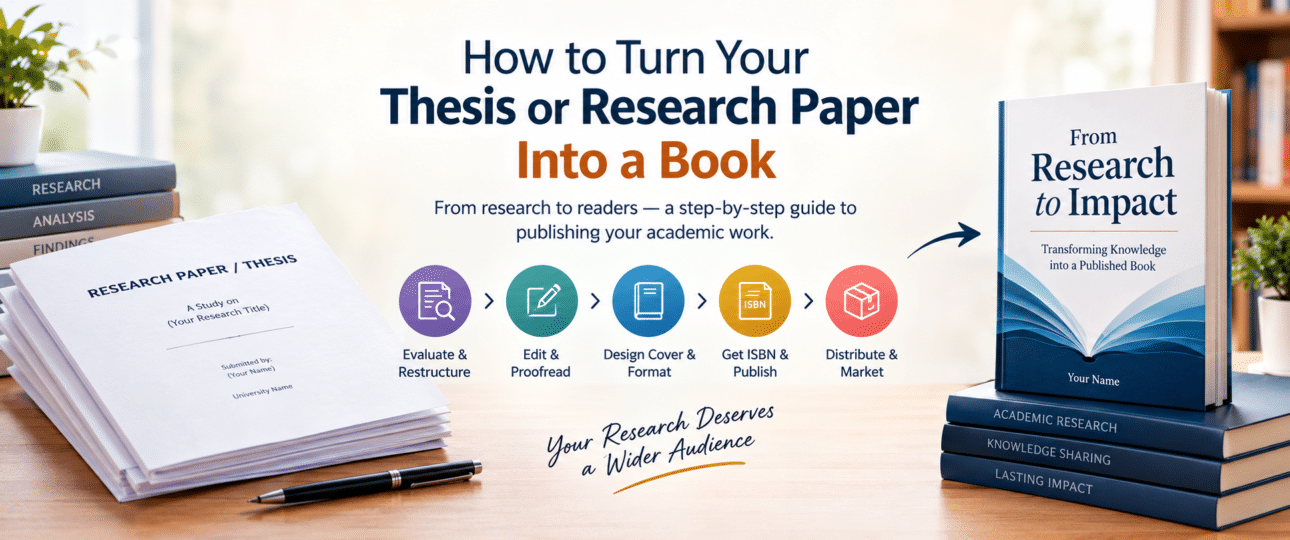
How to Turn Your Research Paper or Thesis Into a Book: A Simple Process
- Evaluate your thesis and research.
- Identify your target audience.
- Define the central idea of the book.
- Restructure the thesis into a reader-focused book.
- Rewrite and shorten the literature review.
- Update research, references, and relevant information.
- Make the academic writing more reader-friendly.
- Remove unnecessary thesis-specific material.
- Check copyright and publication rights.
- Choose a suitable title and subtitle.
- Edit and proofread the manuscript.
- Design the cover and format the interior.
- Obtain the appropriate ISBN.
- Choose a suitable publishing model.
- Publish in relevant formats.
- Distribute the book through appropriate channels.
- Market and promote the published book.
Final Thoughts
Learning how to turn your research paper or thesis into a book is more than simply publishing an existing academic document. The process requires you to identify the right readers, develop a clear central idea, reorganize the chapters, update the research, simplify complex writing where appropriate, check publication rights, edit the manuscript, professionally format the book, obtain an ISBN, select a publishing model, distribute the book, and promote it.
For PhD students, professors, teachers, researchers, consultants, and subject-matter experts, a thesis can provide valuable source material for a professionally developed academic book.
Your thesis represents years of research and effort. With the right adaptation and publishing process, that research can be developed into a book that provides useful knowledge to readers beyond the original academic setting.
Frequently Asked Questions
Is it possible to turn my PhD thesis into a book?
Yes. A PhD thesis can be transformed into a book, but it will generally require restructuring, editing, and adaptation for a book readership.
Can I copy my entire thesis into a book?
The amount of rewriting depends on the discipline, existing manuscript, target audience, and publishing objectives. In many cases, the thesis needs to be reorganized and edited, while material written primarily for academic assessment may need to be shortened or removed.
Can a research paper be turned into a book?
Yes. A research paper can provide source material for a book when the research has sufficient depth and applicability. The paper may need additional research, explanation, examples, and chapters to become a full-length book.
Can I publish a book if parts of my thesis were already published in a journal?
You should first check the copyright and publishing agreements associated with those journal articles. Depending on the agreement, the rights to reuse previously published material may be subject to specific conditions.
Should I remove the literature review from my thesis when making a book?
Not necessarily. Instead of removing it completely, consider reducing it and integrating the most relevant research into the overall argument and discussion of the book.
Do I need professional editing when converting a thesis into a book?
Professional editing can help improve the structure, clarity, consistency, grammar, terminology, and overall readability of a manuscript. The level of editing required depends on the condition and purpose of the manuscript.
Do I need an ISBN for my academic book?
ISBN requirements depend on the publication and publishing arrangement. Authors should check the applicable ISBN requirements and ensure that the title, author, edition, and format information are accurate before publication.
Related Resources
- Learn More About Self-Publishing
- Editing & Proofreading Services
- Book Cover Design & Formatting
- ISBN & Distribution
- Complete Guide to ISBN Registration in India
- What Is Book Formatting?
- Book Marketing & Promotions
- Explore Books
Ready to Turn Your Research Into a Book?
Whether you are a researcher, professor, PhD scholar, teacher, academic, or subject-matter expert, your research can be developed into a professionally prepared book with the right publishing strategy.