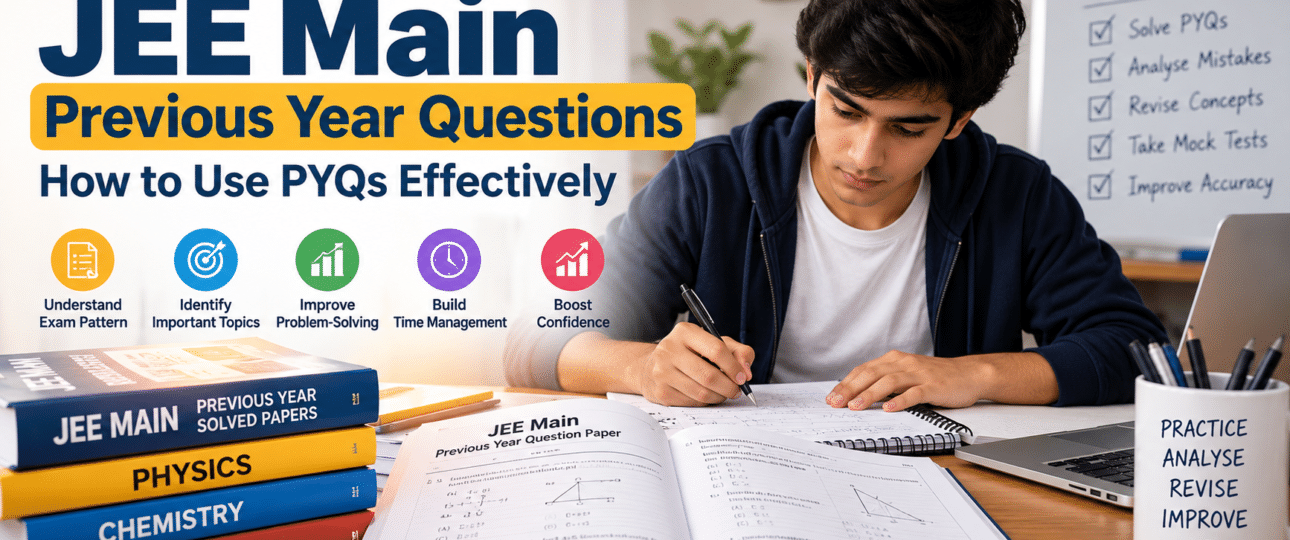
Preparing for JEE Main is not just about completing the syllabus. Students also need to understand how questions are framed, how concepts are applied, and how to manage their time while solving questions. JEE Main Previous Year Questions (PYQs) are an important resource that can help students develop these skills.
JEE Main PYQs can help students understand the question pattern, identify frequently tested concepts, practise questions of different difficulty levels, and improve their approach to solving questions. However, simply solving PYQs once is not enough. Students need to use them strategically throughout their preparation.
At Adhipati Creations, we recognize the value of structured preparation for competitive examinations. In this guide, you will learn how to use JEE Main PYQs effectively, when to start solving them, how to analyse mistakes, and how to include chapter-wise and year-wise PYQs in your preparation strategy.
What Are JEE Main Previous Year Questions?
JEE Main Previous Year Questions are questions that appeared in previous JEE Main examinations. These questions can help students understand how concepts from the syllabus are converted into actual examination questions.
JEE Main PYQs cover different subjects, including:
- Physics: Questions based on concepts, formulas, numerical calculations, graphs, units, and applications.
- Chemistry: Questions covering Physical Chemistry, Organic Chemistry, Inorganic Chemistry, reactions, calculations, and conceptual applications.
- Mathematics: Questions requiring logical thinking, formula application, calculations, and problem-solving skills.
Students can explore the JEE Main preparation books available for structured practice and revision.
PYQs from different years can provide useful practice and help students understand the types of questions that have appeared in previous examinations.
Why Are JEE Main PYQs Important?
JEE Main PYQs can support preparation by giving students practical experience with examination-style questions. Instead of randomly solving questions, students can use previous year questions to understand how concepts are tested and identify areas that require additional revision.
Solving previous year questions can help students:
- Understand the JEE Main question pattern.
- Identify important concepts and topics.
- Improve problem-solving skills.
- Practise time management.
- Test their preparation.
- Identify weak chapters.
- Become familiar with different question formats.
- Improve accuracy.
- Build confidence before the examination.
The main purpose of PYQ practice should not be simply increasing the number of questions solved. Students should also analyse how they solved each question and what they learned from it.
When Should You Start Solving JEE Main PYQs?
Students do not necessarily need to wait until the entire JEE Main syllabus is completed before starting PYQ practice. The right approach can depend on how much of the syllabus has already been covered.
If you have recently completed a chapter, you can start solving chapter-wise JEE Main PYQs related to that topic. This allows you to check whether you can apply the concepts you have just studied.
Students who have already completed around 70–80% of the syllabus can gradually move towards mixed-topic questions and full-paper PYQ practice.
A simple preparation flow can be:
- Master the concept.
- Attempt basic questions.
- Solve chapter-wise PYQs.
- Evaluate your mistakes.
- Revisit weak topics.
- Practise mixed PYQs.
- Gradually include full mock tests.
The important point is to avoid treating PYQs only as a last-minute preparation resource.
How to Use JEE Main PYQs Effectively
Attempting PYQs is useful, but the way you attempt them matters. A strategic approach can help you learn more from every question you solve.
1. Start With Chapter-Wise PYQs
Try solving the previous year questions of a chapter after completing that chapter. For example, after finishing a Physics chapter, practise questions from previous JEE Main examinations related to that topic.
This can help you understand whether you are able to apply the concepts you have learned to actual examination-style questions.
Chapter-wise practice can also help you identify topics that need further revision before moving ahead.
2. Attempt the Question Before Looking at the Solution
One common mistake students make is looking at the solution too quickly. When you see a PYQ, first make a genuine attempt to solve it independently.
Before checking the solution, ask yourself:
- What information is provided?
- What exactly is the question asking?
- Which concept is involved?
- Which formula or method may be useful?
- Is there another possible way to approach the question?
Only look at the solution after making a proper attempt. Even when you cannot solve a question, the attempt itself can help you understand where your preparation needs improvement.
3. Maintain a PYQ Mistake Notebook
Do not simply mark a question wrong and move on. Maintain a separate notebook, document, or digital file where you record important mistakes from your PYQ practice.
You can record mistakes such as:
- Making a calculation mistake.
- Using the wrong formula.
- Misunderstanding the question.
- Forgetting an important concept.
- Taking too much time.
- Selecting the wrong option.
- Failing to identify the correct approach.
Review this collection regularly. Your mistake notebook can become a useful revision resource as the examination approaches.
4. Analyse Every Wrong Answer
Getting a question wrong is not the only issue. Understanding why you got it wrong is much more important for improving your preparation.
After every PYQ practice session, ask yourself:
- Was the mistake conceptual?
- Was it a calculation error?
- Did I misunderstand the question?
- Did I forget a formula?
- Did I spend too much time on the question?
- Was it a careless mistake?
This process helps you identify patterns in your mistakes and decide which topics require more attention.
JEE Main PYQs for Physics
Physics requires students to understand concepts and apply them correctly. While solving JEE Main Physics PYQs, focus on understanding why a particular formula or method is used rather than memorising the final solution.
Important areas to focus on include:
- Concepts used in the question.
- Important formulas.
- Units and dimensions.
- Graph-based questions.
- Numerical calculations.
- Conceptual questions.
- Repeated application patterns.
After solving a question, review the method used and understand the reasoning behind it. This can improve your ability to recognise similar question patterns in future practice.
For additional Physics practice, students can explore JEE Main Smart Solve Physics Class 11 and other JEE Main preparation resources available on Adhipati Creations.
JEE Main PYQs for Chemistry
Chemistry preparation includes Physical Chemistry, Organic Chemistry, and Inorganic Chemistry. JEE Main Chemistry PYQs can help students understand how concepts, reactions, calculations, and NCERT-related information are tested.
While solving Chemistry PYQs, pay attention to:
- Important concepts.
- Frequently tested reactions.
- Calculation-based topics.
- Conceptual applications.
- NCERT-related information.
- Common question formats.
If you get a Chemistry question wrong because of a conceptual gap, return to the relevant theory or notes before continuing with more questions.
Students can also explore JEE Main Smart Solve Chemistry Class XI and JEE Main Smart Solve Chemistry Class XII for additional practice.
JEE Main PYQs for Mathematics
Mathematics requires consistent problem-solving practice. While solving JEE Main Mathematics PYQs, students should focus not only on getting the correct answer but also on selecting an efficient approach.
Important areas include:
- Selecting the correct approach.
- Understanding the question quickly.
- Applying formulas correctly.
- Reducing calculation errors.
- Improving solving speed.
- Identifying alternative methods.
- Tracking the time taken to solve questions.
With regular practice, students can identify which chapters and question types require more attention.
For additional Mathematics practice, you can explore JEE Main Mathematics preparation resources available on Adhipati Creations.
JEE Main PYQs: Year-Wise or Chapter-Wise?
Both chapter-wise and year-wise PYQ practice can be useful at different stages of preparation.
Chapter-Wise PYQs
Chapter-wise practice is useful while you are still completing the syllabus. It allows you to:
- Test a recently completed chapter.
- Understand how concepts are asked in the examination.
- Find weak areas.
- Revise immediately.
- Build topic-wise confidence.
Year-Wise PYQs
Year-wise practice can be useful after you have completed a substantial portion of the syllabus. It allows you to solve questions from different chapters in a more examination-like environment.
A practical approach is to begin with chapter-wise PYQs and gradually add mixed-topic and full-paper practice as your preparation progresses.
You can also explore JEE Main chapter-wise and topic-wise solved papers for systematic practice.
How Many Years of JEE Main PYQs Should You Solve?
There is no single fixed number of years that guarantees a particular result. Instead of focusing only on the number of years, students should focus on the quality and relevance of their PYQ practice.
Try to solve enough previous questions to cover different concepts, chapters, question patterns, and difficulty levels relevant to your preparation.
A useful cycle is:
Solving a large number of questions without reviewing mistakes may provide less benefit than solving a relevant set of questions and analysing them carefully.
JEE Main PYQs and Mock Tests: What Should You Attempt First?
PYQs and mock tests serve different purposes during JEE Main preparation. PYQs help students become familiar with questions asked in earlier examinations and understand how concepts are tested.
Mock tests, on the other hand, help students practise completing an examination-style paper within a fixed amount of time.
A balanced preparation strategy can include both:
- Concept Preparation
- Chapter-Wise PYQs
- Topic Revision
- Mixed PYQs
- Mock Tests
- Mistake Analysis
- Revision
PYQs and mock tests do not necessarily need to replace one another. They can be used at different stages of preparation for different purposes.
Common Mistakes Students Make While Solving JEE Main PYQs
Students can lose the benefit of PYQ practice if they focus only on completing questions instead of learning from them. Some common mistakes include:
- Solving PYQs without understanding the concept: Memorising answers may not help when a similar concept appears in a different format.
- Looking at solutions too quickly: Checking the solution before making a genuine attempt can reduce the opportunity to develop problem-solving skills.
- Ignoring wrong questions: Incorrect questions should be analysed rather than forgotten.
- Not tracking time: Accuracy is important, but students should also become aware of how long they take to solve questions.
- Solving questions without revision: Mistakes and weak concepts should be revisited regularly.
- Treating PYQs as the entire preparation: PYQs should be combined with concept learning, revision, regular practice, and mock tests.
How to Prepare a JEE Main PYQ Timetable
A simple weekly structure can make PYQ practice more organised and easier to track.
You can follow a process such as:
- Complete the selected chapter.
- Revise important concepts and formulas.
- Solve chapter-wise PYQs.
- Mark incorrect and difficult questions.
- Analyse every mistake.
- Revisit the related concept.
- Rework the marked questions after some time.
- Add mixed-topic practice after completing more chapters.
- Gradually include full-length examination practice.
The number of questions can be adjusted according to the amount of time available and your current stage of preparation.
The Importance of a Good JEE Main PYQ Book
A well-organised JEE Main PYQ book can make practice more structured by bringing relevant previous questions together in one place.
A good PYQ resource can help students:
- Access questions systematically.
- Practise subject-wise.
- Revise previous questions.
- Track difficult questions.
- Spend less time searching for questions.
- Keep preparation more organised.
Students who prefer physical books can use a collection of solved papers as part of their regular revision schedule.
Adhipati Creations offers JEE Main preparation books and previous year question resources for systematic practice.
You can also explore JEE Main shift-wise solved papers for additional question practice.
How to Study JEE Main PYQs Before the Exam
As the examination approaches, revision becomes increasingly important. Instead of simply trying to solve more and more new questions, focus on the questions and concepts that have caused problems during your preparation.
Focus on:
- Questions you previously answered incorrectly.
- Questions that took too much time.
- Important formulas.
- Frequently confusing concepts.
- Calculation mistakes.
- Difficult chapters.
- Questions marked for revision.
Reattempting a question that you previously could not solve can sometimes be more useful than continuously adding new questions to your practice list.
JEE Main PYQs: A Smarter Way to Test Your Preparation
Your PYQ score can provide useful information about your preparation, but it should not be the only factor you track.
Instead, consider multiple factors:
- Accuracy
- Time taken
- Understanding of the concept
- Pattern of mistakes
For example, if you are getting questions correct but taking too much time, you may need more time-based practice. If you are solving questions quickly but making frequent mistakes, you may need to focus more on accuracy and careful reading.
The purpose of PYQ practice is not simply to achieve a high practice score. It is to understand your preparation and identify areas where you can improve.
Frequently Asked Questions
1. Are JEE Main Previous Year Questions important?
Yes. JEE Main PYQs can help students understand the types of questions asked in previous examinations, practise concepts, identify weak areas, and become familiar with examination-style problems.
2. When should I start solving JEE Main PYQs?
You can start solving chapter-wise PYQs after completing the relevant concepts. Once you have covered more of the syllabus, you can gradually move towards mixed-topic and full-paper practice.
3. Should I solve JEE Main PYQs chapter-wise or year-wise?
Both approaches can be useful. Chapter-wise PYQs are helpful during syllabus preparation, while year-wise or full-paper practice can be useful for examination-style preparation.
4. Should I solve PYQs before completing the JEE Main syllabus?
You do not necessarily need to wait until the entire syllabus is completed. You can solve chapter-wise PYQs after completing individual chapters.
5. What should I do when I cannot solve a JEE Main PYQ?
First, make a genuine attempt. Then study the solution carefully and identify the concept or approach you missed. Revise that concept and try the question again later.
6. Should I repeat JEE Main PYQs?
Yes. Reattempting difficult or previously incorrect questions can help reinforce concepts and reduce repeated mistakes.
7. Are PYQs enough for JEE Main preparation?
PYQs are an important preparation resource, but they should generally be combined with concept learning, revision, regular practice, and mock tests.
8. Should I use a JEE Main PYQ book?
A well-organised PYQ book can make practice easier by bringing relevant previous questions together in a structured format. Choose a resource that matches your syllabus and preparation requirements.
Final Thoughts
JEE Main Previous Year Questions are not simply an archive of old examination questions. When used correctly, they can help students understand the question pattern, apply concepts, identify weaker areas, and improve accuracy.
The real focus should not be on simply solving more PYQs. A more structured approach is:
Start with chapter-wise questions while studying the syllabus, then gradually move towards mixed-topic and full-paper practice. Continue revising questions where you make repeated mistakes and use your analysis to guide your preparation.
With regular practice and careful analysis, JEE Main PYQs can become an important part of a structured preparation strategy.
Explore the JEE Main preparation books and competitive examination resources available from Adhipati Creations for additional practice and revision.
Related Resources
- JEE Main Preparation Books
- JEE Main Chapter-Wise & Topic-Wise Solved Papers
- JEE Main Shift-Wise Solved Papers
- JEE Main Exam Preparation Set
- JEE Advanced Preparation Books
- JEE Advanced Mathematics Rank Booster
- Explore All Books
Ready to Strengthen Your JEE Main Preparation?
Use JEE Main Previous Year Questions strategically to understand question patterns, practise important concepts, analyse your mistakes, and improve your preparation with consistent revision.