
Writing a book is a big achievement. Finishing your manuscript can be exciting, but a completed manuscript does not always mean that it is ready for publication. Before publishing, a manuscript needs to be checked for clarity, structure, correctness, consistency, readability, and many other factors. This process is known as editing.
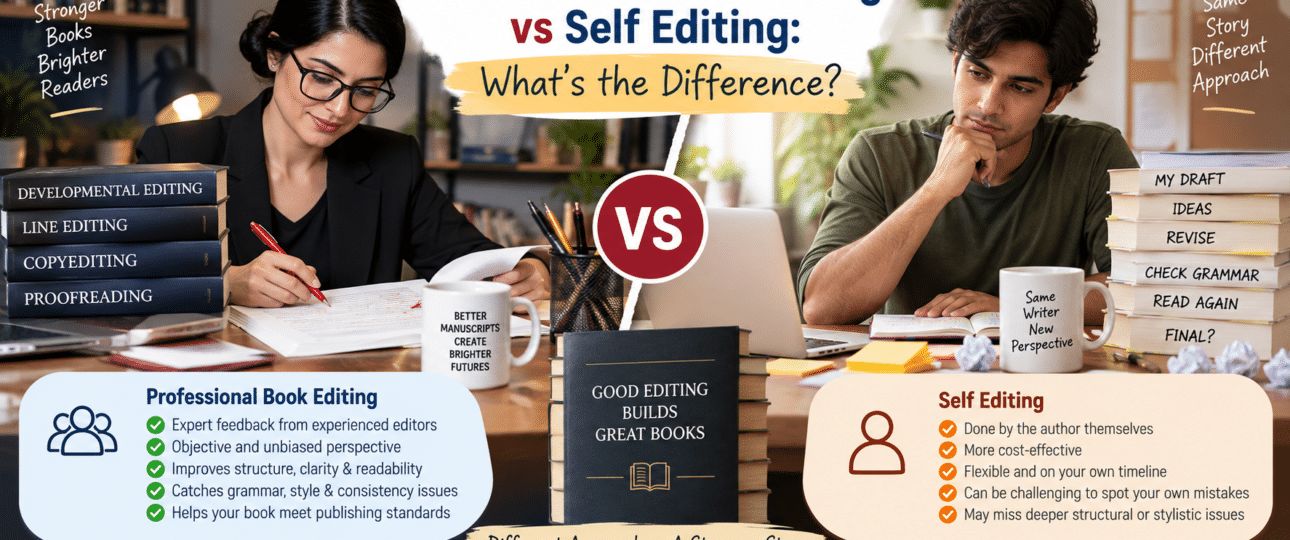
Many authors wonder whether they should edit their book themselves or work with a professional book editor. While self-editing can help identify obvious errors and improve early drafts, professional editing provides an independent perspective that can improve the overall quality of a manuscript.
At Adhipati Creations, we understand how difficult it can be for authors to identify problems in their own work. A professional editor can provide an objective review and help prepare a manuscript for publication. In this article, we explain the difference between professional book editing and self-editing and how both approaches can work together.
What Is Self-Editing?
Self-editing is the process of reviewing and revising your manuscript before submitting it for professional editing or publication. After completing a first draft, an author reviews the manuscript several times to identify obvious problems and improve the overall quality of the writing.
During self-editing, authors can look for issues such as:
- Repeated phrases and words
- Unnecessary words
- Repetitive sentences
- Poor word choices
- Poor paragraph structure
- Inconsistent terminology
- Inconsistent formatting
- Errors and inconsistencies in facts
- Repetitive or redundant information
- Basic formatting issues
Self-editing is an important part of the writing process. It allows authors to improve their manuscript before professional editing begins. However, self-editing also has certain limitations because authors are often too familiar with their own work to notice every issue.
What Is Professional Book Editing?
Professional book editing involves having an experienced editor review the manuscript and provide feedback and recommendations. Depending on the requirements of the book, professional editing may include copy editing, line editing, or substantive editing.
A professional editor may review areas such as:
- Sentence structure
- Grammar
- Flow
- Transitions
- Repeated phrases and words
- Clarity
- Writing style
- Tone
- Logical inconsistencies
- Paragraph structure
- Content contradictions
Whether your book is fiction, non-fiction, academic, educational, or designed for examination preparation, professional editing is about more than correcting grammar. It helps make your writing clearer, more consistent, readable, and effective.
If you are looking for professional support, explore our editing and proofreading services to learn more.
Why Do I Need to Self-Edit?
Self-editing remains important even if you plan to hire a professional editor. Authors can usually remove many basic mistakes before sending their manuscript for professional editing. This helps prepare the manuscript for the next stage of the publishing process.
Self-editing can help you:
- Eliminate misspelled words
- Correct simple grammatical mistakes
- Identify repetitive sections
- Detect poorly constructed sentences
- Spot disorganized chapters
- Ensure names, words, and basic facts are accurate
- Discover areas that need clarification
- Prepare the manuscript for professional editing
Why Can Self-Editing Be Difficult?
The biggest challenge of self-editing is familiarity. Because authors already know what they intended to say, the brain can sometimes fill in gaps or overlook sentences that are unclear or incorrectly written.
Authors may also end up reading what they meant to write rather than what is actually written on the page.
Common self-editing problems include:
- Overlooking errors because the intended meaning is already familiar
- Missing repeated words and phrases
- Becoming attached to particular sentences or paragraphs
- Missing inconsistencies between chapters
- Focusing heavily on grammar while overlooking structural problems
- Finding it difficult to determine whether the content is easy for a new reader to understand
One useful approach is to take a break between finishing your manuscript and editing it. You can also read the manuscript aloud or change the font and reading environment to help identify problems that may not be obvious during normal reading.
Professional Editing vs Self-Editing: Key Differences
- Self-editing: Done by the author, while professional editing is performed by an independent editor.
- Self-editing: The author already knows the content, while a professional editor approaches the manuscript from a reader's perspective.
- Self-editing: Provides a foundation for correcting basic issues, while professional editing can address more complex language and structural questions.
- Self-editing: Helps establish a cleaner first draft, while professional editing helps prepare the manuscript for publication.
- Self-editing: Is generally part of the author's writing process, while professional editing is usually a publishing service.
- Professional editing: Provides an independent and objective perspective that the author cannot provide for their own work.
Both approaches can work together. Self-editing allows the author to polish the manuscript before professional editing, while professional editing provides an impartial second opinion and identifies issues that the author may have overlooked.
Should I Self-Edit Before Submitting My Manuscript to a Professional Editor?
Yes. Authors are generally advised to undertake a thorough self-edit before submitting their manuscript for professional editing. This does not mean that the manuscript needs to be perfect. Instead, it should be as clean and complete as possible, with obvious mistakes already addressed.
Before sending your manuscript to a professional editor, check whether:
- The manuscript is complete.
- All chapters have been included.
- Obvious spelling mistakes have been corrected.
- Chapter titles are consistent.
- Repetitions have been removed.
- Names and terminology are consistent.
- References and sources have been checked.
- Major factual errors have been reviewed.
- The manuscript layout is correctly formatted.
Once these basic checks are complete, professional editing can take the manuscript one step further and address more detailed language, structural, consistency, and readability issues.
When Should You Consider Professional Book Editing?
Professional editing can be particularly useful in several situations. You may want to consider professional book editing when:
- You are publishing your first book.
- Your manuscript is intended for commercial publication.
- You are writing a how-to book.
- You want an independent third-party opinion of your manuscript.
- English is not your strongest writing language.
- Your manuscript contains complex technical information.
- You have completed several rounds of self-editing but are still unsure about the quality of the manuscript.
- You want your book to have a professional publishing standard.
For textbooks and educational books, professional editing can also help ensure that ideas and explanations are clear and easy for the intended readers to understand.
Are Editors Responsible for Changing the Author's Style?
Professional editing does not necessarily mean changing the author's unique voice. A good editor should work with the content and improve clarity, consistency, and readability without unnecessarily changing the author's style.
Before editing begins, authors should communicate their expectations clearly. This can help establish:
- The level of editing required
- The intended audience
- Preferred language conventions
- The author's writing style
- Specific areas that need attention
- Publishing requirements
Clear communication between the author and editor can make the editing process more effective.
Professional Editing Is Just One Piece of the Publishing Puzzle
Getting a professionally edited manuscript is an important part of publishing a book, but there are several other steps involved in preparing a book for readers.
Other important aspects of publishing include:
- Formatting the book for a professional reading experience
- Designing the book cover for print and digital formats
- Registering for an ISBN to identify the book
- Getting the book to market through distribution
- Marketing and promoting the book to readers
- Deciding on pricing and publishing strategy for the intended audience
You can also explore our book cover design and formatting services for additional publishing support.
Authors who want to understand the importance of professional formatting can also read what book formatting is and why it is important for publishing.
How Self-Editing and Professional Editing Work Together
Self-editing and professional editing do not have to be mutually exclusive. Instead, they can complement each other throughout the publishing process.
The author understands the book, its story, purpose, and intended message better than anyone else. At the same time, a professional editor brings an independent perspective and can identify issues that may be difficult for the author to notice.
This combination can be valuable:
The author can perform an initial edit of the manuscript and remove obvious problems. The professional editor can then review the manuscript and identify issues that may have been overlooked during self-editing.
Common Editing Mistakes Authors Should Avoid
First-time authors may make several common editing mistakes. Avoiding these problems can help improve the manuscript before publication.
- Publishing immediately after completing the first draft.
- Assuming spell-check is enough.
- Editing immediately after writing every chapter.
- Making major changes without considering the content of the complete manuscript.
- Ignoring consistency between chapters.
- Failing to seek another perspective when appropriate.
- Removing important material only to reduce the manuscript length.
- Changing the author's voice unnecessarily.
- Skipping proofreading after editing.
- Treating editing as an optional final step.
Even when the content of a manuscript is strong, an independent editorial review can help identify problems that are difficult for the author to see.
How to Submit Your Manuscript for Professional Editing
Before sending your manuscript to an editor, organize the material and clearly explain what you want to achieve. Providing complete information can help the editor understand your requirements.
Ideally, provide:
- The full manuscript
- The chapter order
- The target audience
- The preferred style of language
- Any reference material
- Any terminology or spelling preferences
- Specific issues you want the editor to address
The clearer you are about your objectives and expectations, the easier it can be for the editor to understand the type of editing your manuscript requires.
Frequently Asked Questions
1. Do I need to self-edit a book before publishing it?
Self-editing can improve a manuscript and help remove obvious mistakes, but it may not identify every structural, consistency, style, or grammatical issue. Professional editing can provide an independent review before publication.
2. What is the difference between editing and proofreading?
Editing focuses on areas such as language, structure, clarity, consistency, and readability. Proofreading generally happens later and focuses on remaining issues such as spelling, punctuation, formatting, and typographical errors.
3. Should I edit my book before sending it to a publisher?
Authors should check the submission guidelines of the relevant publisher or literary agent. If a complete manuscript is required, it is generally useful to submit a clean and well-prepared manuscript.
4. Can a professional editor change my writing style?
A professional editor should follow the agreed editing requirements and aim to improve clarity and readability without unnecessarily changing the author's voice.
5. Does a book have to be professionally edited to be published?
Self-published authors can choose their preferred publishing approach. However, professional editing can help identify issues and improve the manuscript before publication.
Related Resources
- Editing & Proofreading Services
- Learn More About Self-Publishing
- Book Cover Design & Formatting
- What Is Book Formatting and Why Is It Important?
- Book Cover Design Mistakes Authors Should Avoid
- Complete Guide to ISBN Registration in India
- Book Marketing & Promotions
Ready to Improve Your Manuscript?
Whether you are a first-time author or an experienced writer, professional editing can help you prepare your manuscript for publication while preserving your unique writing voice.