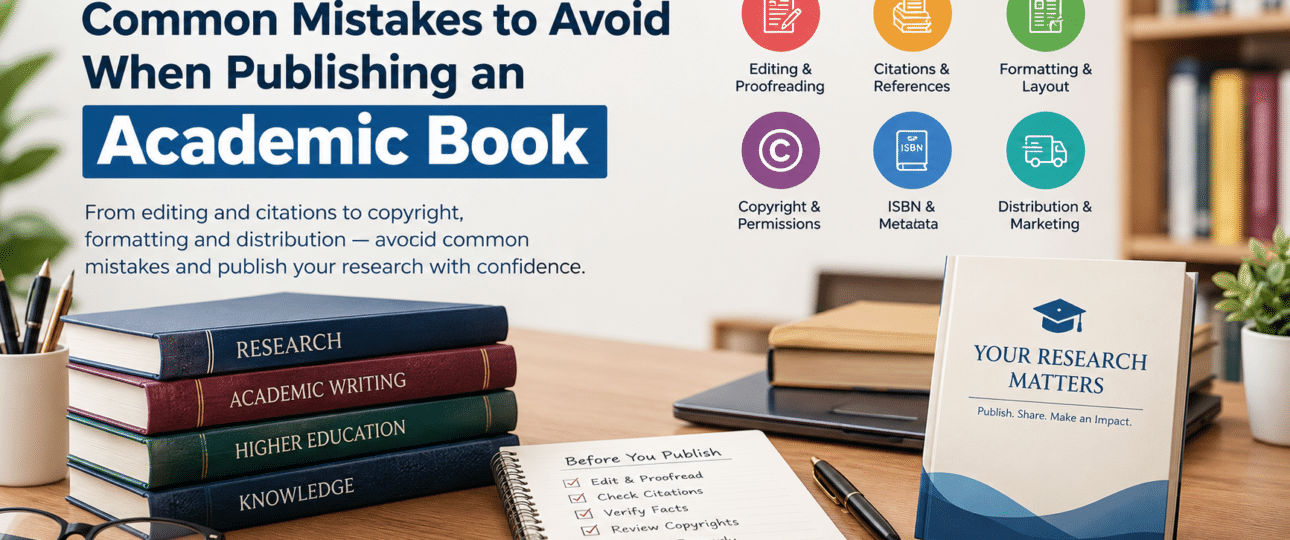
Academic research, professors and teaching staff, subject specialists, and academics publish books for many reasons. Whether you are turning your PhD thesis into a book, publishing a textbook, or publishing primary research, you want your book to be correct, professional, and useful to its readers.
But having an excellent manuscript is just the beginning. There are a lot of errors that many authors commit while editing, formatting, referencing, ISBN registration, copyright management, and distribution. Such errors can lower the quality of the book, cause delay in publication, and will be less acceptable to the academic community.
Fortunately most publishing issues can be avoided by getting the right professional support and undertaking some planning.
Learn everything you need to know about the most common errors when publishing an academic book, as well as effective solutions to get your book ready to hit the shelves.
What Is Academic Book Publishing?
Academic book publishing is the act of converting academic research, educational material, or discipline knowledge into a properly published book.
With academic books you might have:
- Textbooks for schools, colleges, and universities
- Research-based books and specialist monographs
- Books based on PhD theses and dissertations
- Reference books and subject-specific guides
- Preparation books for competitive exams
- Edited volumes and conference proceedings
Academic books differ from general-interest books in their need for specialised attention to research, referencing, terminology, organisation and academic practices.
Regardless of whether you decide to publish on your own or use a professional publisher, knowing the process can save you a lot of money.
A well-prepared academic manuscript needs careful editing, accurate references, professional formatting and a clear publishing plan.
10 Common Mistakes to Avoid When Publishing an Academic Book
1. Publishing Without Proper Manuscript Preparation
A very common error found in the world of academic book publishing is sending in a manuscript that is not completely ready.
Writers may push "send" in the middle of a chapter due to incomplete content, poorly articulated arguments, or lack of sufficient evidence. This leads to excess rounds of revision, disjointed product, and extended timelines.
A manuscript requires structure, a rational arrangement of chapters, use of appropriate terms and a clear aim of the work.
How to Avoid This Mistake
- Complete the material within each section before submitting.
- Organise chapters in a logical sequence.
- Remove duplicate explanations and unnecessary sections.
- Inspect the introduction, aims, and conclusion.
- Make sure all tables, figures, and appendices are included.
Double-check your entire manuscript–rather than piece-by-piece as a series of standalone chapters–before you submit.
2. Skipping Professional Editing and Proofreading
You need to be accurate. Poor spelling, poor grammar, incomplete or incoherent sentences, inconsistent usage of terms and typos can all make even good research less readable.
Others depend completely on automated proofreading software. While automated help will catch many errors, it will not identify specialised terminology, contextual errors or inconsistencies in academic arguments.
Our professional editors can assist with ensuring your manuscript has good structure, flow and is well-presented.
How to Avoid This Mistake
- Give the ms a general once over for its clarity and grammar.
- Check the consistency of academic terminology.
- Verify that arguments are presented logically.
- Get the manuscript professionally edited when necessary.
- Complete a final proofreading round after formatting.
Note that editing and proofreading are different. Editing improves the overall content and language of a text; proofreading searches for remaining issues in the final draft.
3. Selecting the Wrong Publishing Model
Authors of academic articles might opt for a conventional publication, self-publishing, or guided publication without knowing the distinctions.
All of the models have advantages and disadvantages, costs, contractual terms, distribution opportunities and author efforts.
If you select a publishing mode just because it is cheap or because they promise a quick book, then you might regret your choice.
How to Avoid This Mistake
Before selecting a publisher, compare the following:
- Costs of publishing and producing
- Editorial and peer-review processes
- Ownership of Copyright/licence terms
- Royalties and payment schedule
- Print and digital distribution options
- Marketing and advertising assistance
- Rights to future editions and formats
: Obtain a written contract which clearly defines the rights and obligations of the author and publisher.
The appropriate publishing type should match your academic goals, budget, audience and distribution plans.
4. Neglecting to Format Your Book Professionally
A thorough academic book can look unprofessional if its layout is poorly presented and hard to read.
Typical issues are poor page numbering, poor quality mathematical equations, poorly aligned tables, inconsistent fonts, and headings that are not aligned with other pages.
Such issues can make technical material more difficult to comprehend, especially in text books and similar publications.
How to Avoid This Mistake
- Use a consistent heading hierarchy.
- Maintain uniform fonts, spacing, and margins.
- Format tables, charts, and figures consistently.
- Check equations, symbols, and special characters.
- Include a properly structured table of contents.
- Review page breaks, headers, footers, and numbering.
Be sure every equation and symbol is perfect in the final proof, especially in maths, science, engineering, and other technical subjects.
Proper book formatting will improve your academic writing.
5. Missing ISBN and Book Metadata
ISBN An ISBN can identify a specific edition and format of a book. Wrong publication details can cause confusion when cataloging, ordering and distributing.
Some writers delay ISBN registration or inconsistently list the information on the book cover, the title page, the copyright page, and online distribution sites.
How to Avoid This Mistake
- Find out if your publication is going to require an ISBN for its book distribution.
- Use the appropriate ISBN agency to apply where appropriate.
- Check title of book and author/producer.
- Please confirm that your edition is the same as the ISBN.
- Ensure the correct placement of the barcode and ISBN.
- Maintain consistent metadata across distribution platforms.
In India authors and publishers are able to use the official Raja Rammohun Roy National Agency for ISBN. You can see current requirements at isbn.gov.in.
To learn more, see our article on How to get an ISBN Number in India.
6. Creating an Unprofessional Book Cover
The reader's first impression of a book cover A inappropriate design may make an academic book look unprofessional or harder to identify.
Some common problems seen in a speaker deck are: cluttered layout, bad choice of fonts, image quality is low/resolution too low, inconsistent branding, lack of contrast.
Academic books should make very clear about what the book's subject is and for whom it is aimed.
How to Avoid This Mistake
Select a layout suitable for your study area. Choose a typeface which is easy to read and use an obvious visual hierarchy. Make the title and author name are prominent. Use high-resolution, properly licensed images. Check the spine and back-cover layout. Review the cover in full size and thumbnail size.
Concealment should not distract people from the academic aspects.
7. Ignoring Distribution & Marketing
Writing a book is not enough to guarantee discovery.
Certain research authors concentrate exclusively on getting the manuscript written and ignore the marketing process on the assumption that the publisher or online marketplace will carry the works promotional.
An excellent academic book is unlikely to gain limited access by students, researchers, teachers, and libraries without a distribution and marketing plan.
How to Avoid This Mistake
- Identify the primary audience for your book.
- Select suitable online and offline distribution channels.
- Prepare an informative book description.
- Share the publication with relevant academic communities.
- Advertise the book through professional associations and social media.
- Contact institutions, libraries, and educators where relevant.
- Create an author profile and develop an online presence.
Teachers, coaching and training institutes and schools could be special popular destinations for text-books and books meant for examination- preparation.
Get information on book distribution services in India that will help you determine how best to distribute your book.
8. Choosing a Publisher without Checking Its Credibility
It is one of the most significant decisions when publishing a book.
Some authors err by selecting a publishing company just because it has advertised that it will publish quickly, sell the book, or promise success, fame, and fortune in academia.
Having a professional looking web presence or a low publishing fee does not make you a publisher.
How to Avoid This Mistake
- Review the publisher's previously published books.
- Evaluate its editorial quality and work, editorial and production standards.
- Ask about its peer-review or quality-assurance process.
- Verify the distribution channels it actually uses.
- Read the publishing agreement carefully.
- Get a straightforward quote.
- Look for transparent communication and realistic commitments.
Avoid publishers that promise citations or that your research will be renowned or accepted.
You will want to work with a reputable publishing partner that is upfront and transparent with pricing, services, timeline, and contract considerations.
9. Overlooking Citations, References and Research Accuracy
Academic books depend on reliable sources and consistent referencing. Incomplete citations, unverified statistics or incorrectly labelled figures can weaken the quality and credibility of the work.
How to avoid this mistake: Verify facts and statistics, check every citation against its source, follow a consistent reference style and review tables, figures and equations before approving the final proof.
10. Ignoring Plagiarism, Copyright and Permissions
Authors should address plagiarism and copyright concerns before publication. Third-party images, tables, long extracts and previously published material may require permission or an appropriate licence.
How to avoid this mistake: Review the originality of the manuscript, retain source records and permissions, and check the publishing agreement for copyright, licensing and rights to future editions.
Other Advice for Publishing Academic Books
It's all very well to avoid making errors, but having a sensible publishing workflow in place will also streamline the whole process.
Here are some additional practices to follow:
1. Define Your Target Audience
Outline if your book is for students at the undergraduate level, postgraduate students, research workers, professors or a broad public seeking a specialised field.
Your target audience will shape the diction, detail, form, and cost of the publication.
2. Develop a Realistic Publishing Schedule
Develop a schedule for editing, formatting, cover design, proof correction, ISBN work, printing and distribution.
Don't go to press with a date of publication, or give a date, until you can be sure that the essential production steps can all be done by the deadline.
3. Review the Final Proof Carefully
Don't assume a manuscript is free of errors just because it is edited.
Check the final processed copy for omissions, wrong page numbers, equations that failed to render or bad images, and layout shifts.
4. Know Your Rights to Publish
Pay close attention to the publishing agreement, particularly to the copyright, licensing, royalties, distribution and subsequent editions.
Know which rights you are keeping and which rights you are giving to the publisher.
5. Keep Your Publishing Files Organised
Keep digital backups of your final manuscript, permissions, references, publishing agreement, ISBN, cover files, and final approved proofs.
Structured copies are much easier to revise, reprint and produce new editions.
Academic Book Publishing Checklist
Review your package before you send your academic book to the publisher using this checklist.
The manuscript is complete and logically structured.
The content has been edited and proofread.
Facts, statistics, and references have been verified.
Plagiarism and copyright concerns have been addressed.
Tables, figures, equations, and citations are accurate.
The publishing model and contract have been examined.
The book cover and interior pages are professionally formatted.
Checked ISBNs and publication details, where available.
The final proof has been reviewed.
Distribution and marketing plans are in place.
By completing this checklist, you can minimize preventable mistakes, and enhance the quality of your research paper.
Related Resources
FAQs (Frequently Asked Questions)
The most common errors are manuscript submission issues, poor editing, improper referencing, plagiarism, copyright infringement, inconsistent presentation, wrongly formatted data, wrong metadata and poor marketing.
Authors can run into difficulty planning each stage.
A book need not always have a professional edit before being published, but it can definitely contribute greatly to the overall tone, style, grammar, consistency and clarity of a work. Especially helpful for complicated manuscripts, first time authors, and books targeting academic and professional readers.
Yes. But you will need to do a lot of rewriting before the thesis will make an interesting and coherent book. For example, you might want to reorganize parts of the thesis, cut out a lot of repetition, and revise the text to meet your reader’s needs.
Also, check your university’s rules and any policy on work you have published before.
The ISBN is helpful in tracking and selling academic books through bookstores, libraries, and other book distribution networks. When a number is necessary is different depending on what the material will be published on and if it will be distributed through a third party. An ISBN does not offer any copyright security.
Consider the publisher’s editorial policies, their published guidelines, production values, distribution system, the cost, the contracts and policies and interaction with the publisher. Select a publisher whose publication services and model will suit your needs.