
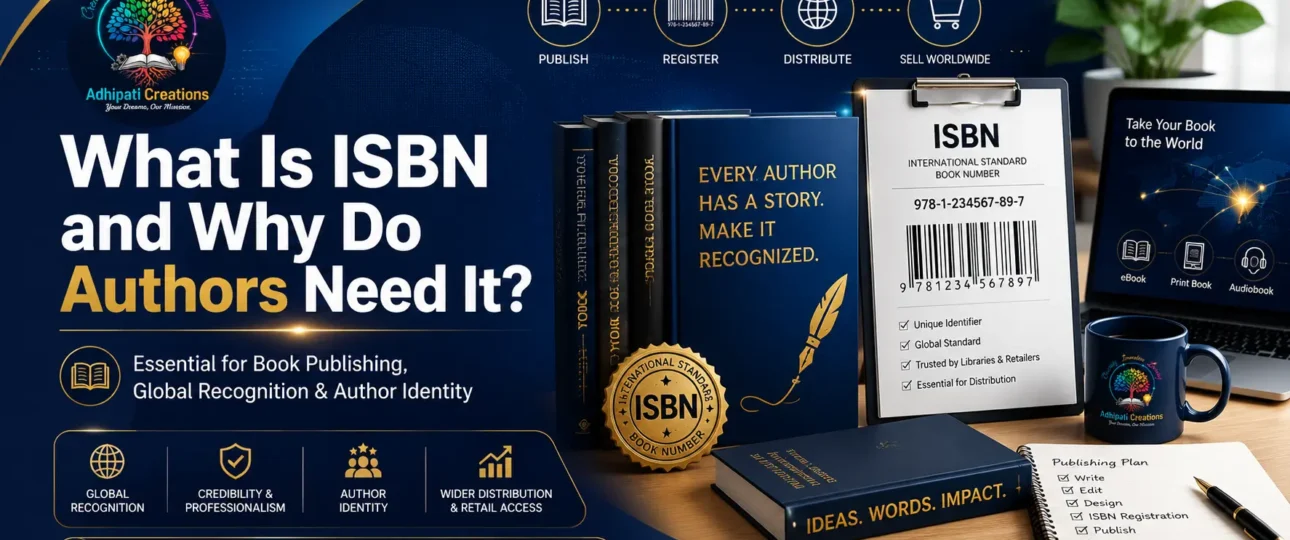
If you are an author — whether you are publishing your first book or your tenth — you have probably heard the term ISBN for books. But what exactly is it? Why does it matter so much? And do you really need one?
In this blog post, we will break down everything you need to know about ISBN meaning, its role in the publishing world, and how it directly benefits you as an author. By the end, you will understand why getting an ISBN number is not just a formality — it is a smart business decision.
What Is ISBN? Understanding the Basic ISBN Meaning
ISBN stands for International Standard Book Number. It is a unique 13-digit number (older books used a 10-digit version) that is assigned to every published book. Think of it as a book's personal ID card — no two books share the same ISBN.
The full form is simple enough, but the real ISBN meaning goes much deeper than just a number. It is a globally recognized system used by publishers, booksellers, libraries, and distributors all around the world to identify and track books.
Here is an example of what an ISBN looks like:
978-0-06-112008-4
This number is usually printed on the back cover of a book, right above the barcode. You will also find it on the copyright page inside the book.
The International ISBN Agency, based in London, oversees the entire system. Each country has its own ISBN agency that issues numbers to publishers and authors.
A Short History of ISBN
The ISBN system was first developed in the United Kingdom in 1966 and was later adopted internationally in 1970. Before ISBN existed, there was no standard way for booksellers and libraries to identify books. Ordering and tracking books was confusing and error-prone.
The 10-digit ISBN was the global standard for decades. Then, in 2007, the publishing world switched to the 13-digit ISBN system (also called ISBN-13) to align with the global barcode standard called EAN-13. If you have an older 10-digit ISBN, it can be converted to a 13-digit one by adding the prefix 978.
How Is an ISBN Number Structured?
Understanding the structure of a book ISBN helps you see just how much information it carries. A 13-digit ISBN is divided into five parts:
- Prefix Element – Either 978 or 979 (used globally)
- Registration Group Element – Identifies the country or language group
- Registrant Element – Identifies the specific publisher or self-publishing author
- Publication Element – Identifies the specific edition or format of the book
- Check Digit – A single digit at the end used to validate the number
So when you look at a book ISBN, you are actually reading a coded system that tells the world who published the book, where it came from, and which exact version it is.
Why Is ISBN Important for Books?
The short answer: without an ISBN, your book is invisible to the global publishing system.
1. It Gives Your Book a Unique Global Identity
Every format of your book — hardcover, paperback, ebook, audiobook — gets its own ISBN. This means that even if you publish the same book in three different formats, each version has its own identity. Bookstores, libraries, and online retailers can easily distinguish between them.
2. It Helps Retailers and Libraries Find and Stock Your Book
Booksellers and librarians use ISBN numbers to search for and order books. If your book does not have an ISBN, it simply does not exist in their system. A library cannot catalogue your book. A bookstore cannot place an order for it. You are completely off the grid.
3. It Makes Your Book Searchable Online
When someone searches for your book on Amazon, Google Books, or any other platform, the ISBN number is how those systems identify and pull up your book. It is the most reliable way to find the exact edition of a book you are looking for.
4. It Builds Credibility and Professionalism
An ISBN signals that you are a serious, professional author. Even if you are self-publishing, having an ISBN shows readers, reviewers, and media that your book is a legitimate, properly published work — not just a hobby project.
ISBN Ka Role: The Role of ISBN in the Publishing World
Distribution Networks
Major book distributors like Ingram and Baker & Taylor use ISBNs to manage millions of titles. Without an ISBN, your book cannot enter these distribution channels, which means it cannot reach thousands of bookstores and libraries around the world.
Metadata Management
Every ISBN is connected to metadata — information about your book like the title, author name, description, price, and categories. This metadata travels with your book across every platform and database. Good metadata attached to a proper ISBN helps readers discover your book organically.
Library Cataloguing
Libraries around the world use the ISBN system to catalogue their collections. If your book has a valid ISBN, it can be added to library databases, increasing its visibility and reach.
Point-of-Sale Systems
Every time a book is sold in a physical bookstore, the barcode (which is generated from the ISBN) is scanned at checkout. This is how sales data is tracked.
Author Identification: How ISBN Connects a Book to Its Author
One of the less talked about but very important aspects of ISBN for books is author identification.
When you register an ISBN, you provide details about yourself as the publisher or author. This information becomes part of the global book database.
- Your book is officially linked to your name
- Your publishing identity is established in the industry
- Any book you publish under the same ISBN prefix is traceable back to you
This is especially important for self-publishing authors who want to build a recognizable brand.
Sales & Tracking Benefits of Having an ISBN Number
One of the biggest practical advantages of having an ISBN number is the ability to track sales.
Industry Sales Reports
Organizations like Nielsen BookScan use ISBNs to track book sales across thousands of retail points.
Royalty Tracking
If you publish through a distributor or retailer network, they use your ISBN to track how many copies were sold and calculate your royalties accurately.
Market Analysis
As an author or independent publisher, you can use ISBN-based sales data to understand your audience and improve your marketing strategy.
Preventing Piracy and Plagiarism
An ISBN also serves as proof of your book's originality and registration date.
ISBN for Self-Publishing Authors: Do You Really Need One?
This is a question many new writers ask: Is ISBN for self-publishing authors really necessary?
The honest answer is yes — if you are serious about your writing career.
Some self-publishing platforms like Amazon KDP allow you to publish without your own ISBN. But there are important limitations:
- You cannot distribute through other retailers without an ISBN
- You lose control over your book's metadata
- The ISBN is owned by the platform, not you
- You appear less credible to libraries and reviewers
Purchasing your own ISBN gives you full control over your book as an intellectual property. If you are planning to publish professionally, services like self-publishing, book cover design & formatting, and editing & proofreading also play an important role.
Common Myths About ISBN Numbers
Myth 1: "ISBN means my book is copyrighted."
❌ False. ISBN and copyright are two separate things.
Myth 2: "One ISBN works for all formats."
❌ False. Every format — print, ebook, audiobook — needs its own unique ISBN.
Myth 3: "I can reuse my ISBN for a new edition."
❌ False. Revised editions need a new ISBN.
Myth 4: "Free ISBNs from platforms are just as good."
⚠️ Partially true. Your own ISBN is always better.
Quick Summary: Why Every Author Needs an ISBN
| Benefit | Why It Matters |
|---|---|
| Global Identity | Unique number recognized worldwide |
| Retail & Library Access | Bookstores and libraries can stock your book |
| Online Discoverability | Easier to find on Amazon, Google Books, etc. |
| Author Identification | Links all your books to your name |
| Sales Tracking | Accurate royalties and market data |
| Professional Credibility | Signals you are a serious, legitimate author |
| Distribution | Access to major distribution networks |
“An ISBN for books is not just a technical requirement. It is your book's passport to the global publishing world.”
Conclusion
Understanding what is ISBN number and why it matters is one of the first steps toward becoming a professional author.
Whether you are writing a novel, a non-fiction guide, or preparing your manuscript with proper book formatting, every detail matters.
An ISBN for books is not just a technical requirement. It is your book's passport to the global publishing world.
To improve your publishing success, investing in professional book cover design, editing & proofreading, and book marketing & promotions can make a huge difference.
So if you are working on your next book, do not treat the ISBN as an afterthought. Get your ISBN number early, attach it to proper metadata, and give your book the best possible chance to succeed.
Because great stories deserve to be found. 📚