Writing and publishing an academic book is one of the most rewarding milestones in a scholar's career. It strengthens your academic profile, contributes valuable knowledge to your field, and often becomes an important achievement for research recognition, career growth, and institutional advancement. However, for many first-time authors, the process of academic book publishing in India can seem complex and confusing.
Whether you're a professor, researcher, PhD scholar, lecturer, or subject-matter expert, understanding the publishing process is the first step toward transforming your research into a professionally published book.
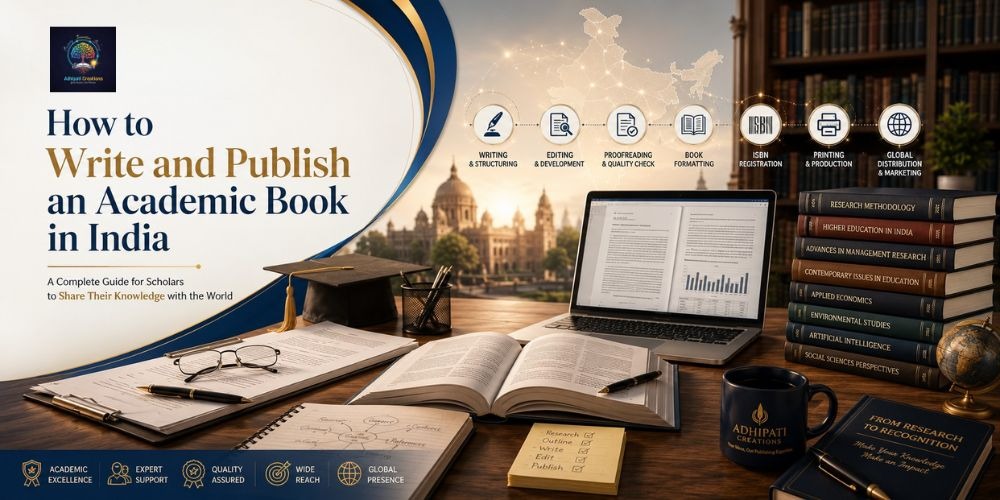
At Adhipati Creations, we help researchers and educators navigate every stage of the publishing journey—from manuscript preparation and professional editing to book design & formatting, ISBN registration, publishing, distribution, and marketing support.
In this comprehensive guide, you'll learn everything you need to know about academic book publishing in India, including how to prepare your manuscript, choose the right publishing model, meet publishing standards, and successfully publish your academic work in both print and digital formats.
Let's explore the complete publishing process step by step.
An academic book is more than a publication—it is a lasting contribution to knowledge that strengthens your professional reputation and research impact.
What is Academic Book Publishing?
Academic book publishing is the process of converting scholarly research, educational content, or professional expertise into a professionally published book that can be used by students, researchers, educators, institutions, and professionals.
Unlike general books, academic publications are based on evidence, structured research, verified references, and subject expertise. They often include original research, literature reviews, case studies, theoretical frameworks, data analysis, or practical insights related to a specific discipline.
An academic book may cover subjects such as education, engineering, medicine, law, economics, business management, computer science, social sciences, humanities, environmental studies, or any other specialized field.
A professional publishing partner can help authors with every stage of the process, including:
- Academic editing and proofreading
- Book cover design and interior formatting
- ISBN registration and distribution
- Paperback and eBook publishing
- Printing and Print-on-Demand services
- Distribution through Amazon and other online bookstores
- Book marketing and promotional support
Unlike traditional academic publishing, many assisted publishing models allow authors to retain ownership of their manuscript while receiving professional publishing assistance throughout the entire process.
If you're publishing your first academic book, you may also find these resources helpful:
- What is an ISBN and Why Authors Need It?
- How to Get an ISBN Number in India
- Publishing Plans & Pricing
Academic publishing transforms years of research into a professionally published resource that educates, inspires, and contributes to future scholarship.
Why Publish an Academic Book in India?
Academic publishing in India has grown rapidly over the past decade. Universities, research institutions, colleges, and independent scholars are producing more research than ever before, creating a strong demand for quality academic publications.
Today, publishing an academic book is not only a matter of professional pride but also an important milestone for career development. Many faculty members publish books to support promotions, institutional evaluations, research visibility, and academic recognition.
Some of the major reasons why academic book publishing is becoming increasingly popular in India include:
- Growing research output – Indian universities and research institutions are producing a significant amount of original research every year.
- Career advancement – Published books enhance academic portfolios and often contribute toward faculty promotions, API scores, and institutional recognition.
- Greater visibility – Publishing allows researchers to share their work with students, educators, policymakers, and professionals across India and internationally.
- Digital accessibility – Modern publishing enables books to be available in paperback, Kindle, and other digital formats through online platforms.
- Affordable publishing solutions – Professional assisted publishing services have made academic publishing more accessible for first-time authors.
- Long-term academic impact – A well-written academic book continues to educate readers and generate citations for years after publication.
With the support of experienced publishing partners like Adhipati Creations, scholars can focus on their research while experienced professionals manage editing, publishing, formatting, ISBN registration, and distribution.
Publishing an academic book is not just about printing your research—it is about sharing knowledge, building authority, and creating a lasting academic legacy.
Step 1: Choose the Right Topic and Define Your Scope
Every successful academic book begins with a well-defined topic. Before writing your first chapter, spend enough time identifying a subject that is relevant, valuable, and capable of making a meaningful contribution to your field. A clearly focused topic not only improves the quality of your manuscript but also makes it easier for publishers and readers to understand the purpose of your book.
Many first-time academic authors make the mistake of selecting a topic that is too broad. As a result, the manuscript often loses focus and becomes difficult to organize. Instead, choose a specific subject where you can provide original insights, practical knowledge, or research-backed analysis.
Before you begin writing, ask yourself the following questions:
- Does this topic offer a fresh perspective or original contribution?
- Who is the primary audience—students, researchers, educators, professionals, or policymakers?
- Will the subject remain relevant over the coming years?
- Can the topic be developed into a complete academic book instead of a journal article or research paper?
- Does my research provide enough evidence and references to support the content?
One of the best ways to stay organized is by preparing a one-page book proposal before starting your manuscript. This proposal should briefly explain your book's objective, intended audience, expected outcomes, chapter structure, and the unique value your work brings to existing literature.
If you're publishing your first academic book, choosing the right publishing partner early in the process can save considerable time later. Professional Self Publishing Services can guide authors through planning, editing, formatting, and publishing with expert assistance.
A clearly defined topic is the foundation of every successful academic book. Strong planning today prevents major revisions tomorrow.
Step 2: Conduct Thorough Research
Research is the backbone of every academic publication. Unlike general non-fiction books, academic books must be supported by credible evidence, verified references, and structured analysis. Readers, reviewers, and educational institutions expect academic publications to maintain a high standard of accuracy and originality.
Before writing your manuscript, invest sufficient time in reviewing existing literature. Understanding previous studies helps you identify research gaps and ensures that your book contributes something valuable rather than repeating information that already exists.
A systematic research process should include:
- Reviewing published books, research papers, and scholarly articles related to your subject.
- Using reliable academic databases such as Google Scholar, JSTOR, Scopus, Web of Science, and UGC-CARE listed journals.
- Collecting recent statistics, case studies, and practical examples that strengthen your arguments.
- Maintaining proper references using citation styles such as APA, MLA, Chicago, or IEEE, depending on your discipline.
- Keeping detailed notes to simplify citation management during the writing process.
Remember that readers trust academic books because every statement is expected to be supported by reliable evidence. Accurate citations also reduce the risk of plagiarism and improve the credibility of your work.
Before submitting your manuscript for publication, it is advisable to perform professional editing and proofreading to ensure consistency, clarity, grammar, and proper citation formatting throughout the book.
If your manuscript is intended for commercial publishing, you should also understand the importance of obtaining an ISBN Number and Distribution Services, which allow your book to be catalogued, distributed, and sold through major online bookstores.
Strong research builds trust. Every credible academic book is supported by reliable evidence, accurate citations, and original thinking.
Many experienced academic authors spend more time researching than writing. This investment significantly improves the overall quality of the manuscript and increases its value for students, educators, and researchers.
Once your research is complete, the next step is organizing your ideas into a logical chapter structure. A detailed outline not only improves the writing process but also helps publishers evaluate the overall quality and flow of your manuscript.
Excellent academic books are planned before they are written. A structured research process leads to stronger arguments, better organization, and higher publication quality.
Step 3: Create a Detailed Book Outline
Once your research is complete, the next step is creating a structured outline for your academic book. A detailed outline serves as a roadmap that guides your writing process and ensures every chapter contributes to the overall objective of the book.
Without a proper outline, authors often find themselves repeating ideas, missing important concepts, or presenting information in an illogical sequence. Planning the structure before writing saves time and produces a more coherent manuscript.
A standard academic book generally follows a structure similar to this:
- Preface or Foreword – Introduces the purpose and background of the book.
- Introduction – Explains the research problem, objectives, scope, and significance of the study.
- Literature Review – Discusses previous research and identifies existing knowledge gaps.
- Core Chapters – Presents your original research, concepts, models, case studies, analysis, or findings.
- Research Methodology – Explains the research methods used, especially for data-driven academic books.
- Conclusion – Summarizes major findings and highlights future research opportunities.
- References or Bibliography – Lists all cited sources using the appropriate citation style.
- Appendices – Includes supporting material such as questionnaires, charts, datasets, or additional documentation.
Creating a chapter outline before writing allows you to maintain consistency, avoid duplication, and present information in a logical flow. Publishers and reviewers also appreciate manuscripts that follow a clear academic structure.
A well-planned outline transforms complex research into a clear, organized, and reader-friendly academic book.
Step 4: Write With Clarity and Academic Rigor
With your outline in place, it's time to begin writing. Academic writing should be informative, evidence-based, and easy to understand. Many first-time authors believe academic books must use complicated language, but in reality, clarity is one of the strongest indicators of quality.
Your objective should be to explain complex ideas in a structured and understandable manner while maintaining academic integrity.
Keep these writing principles in mind throughout your manuscript:
- Write clearly and precisely. Avoid unnecessary jargon whenever simpler language can communicate the same idea.
- Maintain consistency. Use the same terminology, formatting, and citation style throughout the book.
- Support every argument. Back your statements with reliable references, statistics, research findings, or case studies.
- Present original insights. Publishers look for books that contribute something valuable rather than simply repeating existing literature.
- Write regularly. Setting weekly writing goals helps maintain momentum and improves productivity.
Many successful academic authors prefer writing one section at a time instead of trying to complete entire chapters in one sitting. This approach improves focus and reduces writer's block.
During the writing process, don't worry about making every sentence perfect. Focus on completing the manuscript first. Refinement comes later during editing.
Academic excellence is achieved through clarity, consistency, and evidence—not by using unnecessarily complex language.
Step 5: Edit, Proofread, and Get Peer Feedback
Completing your first draft is a significant milestone, but it is not the final stage of publishing. Editing is where your manuscript evolves from a rough draft into a professional academic publication.
Every academic manuscript should undergo multiple rounds of review before publication. Even experienced authors rely on editors and peer reviewers to identify errors, improve clarity, and strengthen arguments.
A comprehensive editing process should include:
- Structural Editing – Review chapter organization, logical flow, and consistency of arguments.
- Language Editing – Correct grammar, punctuation, sentence structure, and readability.
- Citation Review – Verify that every reference follows the required citation style and matches the bibliography.
- Plagiarism Check – Ensure originality before submission. Most academic publishers expect manuscripts to pass plagiarism screening.
- Peer Review – Ask colleagues or subject experts to evaluate your work and provide constructive feedback.
Professional Editing & Proofreading Services can significantly improve the overall quality of your manuscript by eliminating language errors, improving readability, and ensuring that the content meets academic publishing standards.
At this stage, many authors also begin preparing for the technical publishing process, including book formatting and cover design, ensuring the manuscript is publication-ready.
Great academic books are not written once—they are refined through careful editing, expert feedback, and continuous improvement.
After your manuscript has been professionally edited and finalized, the next step is obtaining an ISBN, understanding copyright requirements, and selecting the publishing model that best suits your academic goals.
Step 6: Understand ISBN, Copyright, and Legal Requirements
Before your academic book is published, there are several legal and publishing formalities that must be completed. These requirements ensure that your book is officially recognized, protected, and available for distribution through bookstores, libraries, and online platforms.
Many first-time authors are unfamiliar with these procedures, which is why working with an experienced publishing company can make the entire process much easier.
The most important publishing requirements include:
- ISBN (International Standard Book Number) – A unique identification number that allows your book to be catalogued, distributed, and sold through bookstores and online platforms.
- Copyright Protection – Although copyright exists automatically when you create original work, formal registration provides stronger legal protection against unauthorized reproduction.
- Publishing Metadata – Accurate author information, keywords, categories, edition details, and descriptions improve discoverability on online marketplaces.
- Institutional Compliance – Depending on your objectives, your book may need to align with university or institutional publishing standards.
Authors who are publishing for the first time often benefit from professional guidance in obtaining an ISBN and preparing all the required publishing documentation. Our ISBN Registration & Distribution Services simplify this process while ensuring your book is publication-ready.
You can also explore these helpful resources before beginning the registration process:
An ISBN gives your academic book a professional identity and makes it discoverable through libraries, bookstores, and online marketplaces worldwide.
Step 7: Choose the Right Publishing Model
One of the biggest decisions every academic author must make is choosing the right publishing model. Each option offers different advantages depending on your publishing goals, timeline, budget, and desired level of control.
In India, academic authors generally choose one of the following publishing routes:
1. Traditional Publishing
Traditional publishers evaluate your manuscript before deciding whether to publish it. If accepted, they usually handle editing, printing, distribution, and marketing while paying the author royalties.
Although traditional publishing carries academic prestige, it is highly competitive and the review process may take several months or even years.
- Publisher bears publishing costs
- Long review and approval process
- Lower royalty percentage
- Limited creative control
2. Self Publishing
Self publishing allows authors to publish independently while retaining complete ownership of their manuscript, pricing, copyright, and royalties.
Authors are responsible for editing, formatting, publishing, and marketing unless they hire professionals to assist them.
Professional Self Publishing Services help simplify this process while allowing authors to retain full ownership of their work.
- Complete creative freedom
- Higher royalty earnings
- Faster publishing timeline
- Greater responsibility for production and promotion
3. Assisted or Hybrid Publishing
Assisted publishing combines the advantages of self publishing with professional publishing support. The author retains ownership of the manuscript while experienced publishing professionals handle editing, formatting, cover design, ISBN registration, printing, distribution, and publishing.
This model has become increasingly popular among professors, researchers, educators, and PhD scholars because it offers professional quality without the long waiting periods associated with traditional publishing.
At Adhipati Creations, our assisted publishing solutions are designed to help academic authors publish confidently while maintaining complete ownership of their intellectual work.
Assisted publishing combines professional publishing expertise with author ownership, making it one of the most preferred options for academic authors today.
Self Publishing vs Traditional Publishing — Quick Comparison
Choosing the right publishing model depends on your priorities. The table below highlights the major differences between traditional publishing and self publishing for academic authors.
| Feature | Self Publishing | Traditional Publishing |
|---|---|---|
| Publishing Time | Few weeks | Several months or longer |
| Ownership | Author retains complete rights | Rights may be partially assigned |
| Creative Control | Complete control | Publisher makes many decisions |
| Royalty | Higher earnings per sale | Generally lower royalty |
| Publishing Cost | Author invests in publishing services | Publisher usually covers expenses |
| Approval Process | No lengthy approval required | Competitive manuscript selection |
| Publishing Speed | Fast | Slow |
For many first-time academic authors, assisted self publishing offers the ideal balance of professional publishing quality, faster turnaround, and complete ownership.
The best publishing model is the one that aligns with your academic goals, publication timeline, and long-term career aspirations.
Step 8: Design a Professional Cover and Interior Layout
Although academic books are primarily judged by the quality of their content, presentation also plays an important role. A professionally designed cover and a clean interior layout create a strong first impression and improve the overall reading experience for students, researchers, educators, and professionals.
A poorly formatted manuscript can reduce the credibility of excellent research. That's why publishers and academic institutions expect books to follow consistent formatting standards throughout the publication.
Some essential elements of professional academic book design include:
- Clear and readable typography suitable for academic reading.
- Consistent chapter titles, headings, and subheadings.
- Well-organized tables, figures, illustrations, and diagrams.
- Proper page numbering and table of contents.
- High-quality formatting for both paperback and eBook editions.
- A professionally designed cover that reflects the subject of the book.
Professional Book Cover Design & Formatting Services ensure that your manuscript meets publishing standards while giving your academic work a polished and professional appearance.
Excellent research deserves excellent presentation. A professionally designed academic book builds credibility before the reader even opens the first page.
Step 9: Plan Your Book's Distribution and Marketing
Publishing your book is only the beginning. To maximize the impact of your research, your book should be easily accessible to readers across universities, libraries, bookstores, and online platforms.
A successful distribution strategy helps your research reach the people who can benefit from it the most.
Some effective ways to increase your book's visibility include:
- Publishing on Amazon, Flipkart, and other leading online bookstores.
- Making your book available through Print-on-Demand services.
- Submitting copies to university and institutional libraries.
- Sharing your publication through academic conferences and seminars.
- Promoting key insights from your book on LinkedIn and professional social media platforms.
- Encouraging peer reviews and academic citations.
- Distributing complimentary copies to reviewers, educators, and subject experts.
Many authors overlook book marketing, but visibility is essential if you want your research to reach students, educators, policymakers, and fellow researchers.
Professional Book Marketing & Promotion Services can help improve discoverability through online promotion, launch strategies, and digital marketing support.
Publishing makes your book available. Effective marketing ensures your research is actually discovered, read, and cited.
Step 10: Partner With the Right Publishing Team
The final step in your publishing journey is choosing the right publishing partner. An experienced publishing company not only simplifies the publishing process but also helps maintain the academic quality of your manuscript.
Before selecting a publisher, evaluate the services they provide and ensure they understand the unique requirements of academic publishing.
A reliable publishing partner should offer:
- Experience in publishing academic and research-based books.
- Professional editing and proofreading.
- High-quality cover design and formatting.
- ISBN registration and distribution support.
- Transparent pricing without hidden charges.
- Paperback and eBook publishing solutions.
- Distribution through leading online bookstores.
- Clear royalty structure and complete ownership for authors.
At Adhipati Creations, we work closely with professors, educators, researchers, scientists, and subject experts to transform their manuscripts into professionally published academic books.
From manuscript evaluation and editing to publishing, distribution, ISBN registration, and marketing support, our experienced publishing team guides authors through every stage of the publishing process.
The right publishing partner doesn't simply print your manuscript—they help transform years of research into a professionally published academic resource.
Final Thoughts
Academic book publishing in India is a rewarding journey that combines research, planning, writing, editing, and professional publishing support. While the process may appear challenging at first, breaking it into structured steps makes it far more manageable.
From selecting the right topic and conducting comprehensive research to choosing the appropriate publishing model and promoting your finished book, every stage contributes to the overall success of your publication.
If you're looking for a publishing partner who understands academic standards and supports authors throughout the entire journey, Adhipati Creations provides comprehensive publishing solutions designed specifically for scholars, educators, researchers, and first-time academic authors.
Whether you need editing and proofreading, professional formatting, ISBN registration, or book marketing support, our experienced publishing professionals are here to help you publish with confidence.
Every influential academic book begins with a single idea. The right publishing partner helps that idea become a lasting contribution to education and research.
Choosing an experienced publishing partner allows authors to focus on research while professionals manage the technical aspects of publishing.
Related Publishing Resources
If you're planning to publish your academic book, these resources will help you understand every stage of the publishing process:
- Self Publishing Services
- Editing & Proofreading Services
- Book Cover Design & Formatting
- ISBN Registration & Distribution
- Book Marketing & Promotion Services
- Publishing Plans & Pricing
- What is an ISBN and Why Authors Need It?
- ISBN Registration in India – Complete Guide
- Read More Publishing Blogs
Ready to Publish Your Academic Book?
Whether you're writing a research book, textbook, reference book, thesis-based publication, professional handbook, or educational guide, choosing the right publishing partner can make the entire process faster, easier, and more professional.
Adhipati Creations offers complete academic publishing support—from manuscript review and professional editing to cover design, formatting, ISBN registration, publishing, printing, distribution, and marketing—allowing you to focus on what truly matters: sharing your knowledge with the world.
Our experienced publishing team understands the unique requirements of professors, researchers, institutions, and first-time academic authors, ensuring your manuscript meets high publishing standards while maintaining your complete ownership.
Your research has the power to educate future generations. Let it become a professionally published academic book that creates a lasting impact.
Frequently Asked Questions (FAQs)
Academic book publishing is the process of publishing scholarly work, research, educational content, or subject-specific knowledge in the form of a professionally published book. Academic books are generally written for students, researchers, educators, professionals, and academic institutions.
Anyone with valuable academic knowledge or original research can publish an academic book. This includes:
- Professors
- PhD Scholars
- Researchers
- College Lecturers
- Scientists
- Subject Experts
- Industry Professionals
Even first-time authors can successfully publish an academic book with the guidance of experienced Self Publishing Services.
Yes. An ISBN (International Standard Book Number) is highly recommended if you want your book to be sold through online bookstores, listed in library catalogues, and recognized professionally.
You can learn more about ISBN registration through our detailed guide on ISBN Registration in India.
The publishing timeline depends on the quality of the manuscript and the services required. In most cases, assisted publishing can take anywhere between 3 to 8 weeks, whereas traditional publishing may take several months or longer.