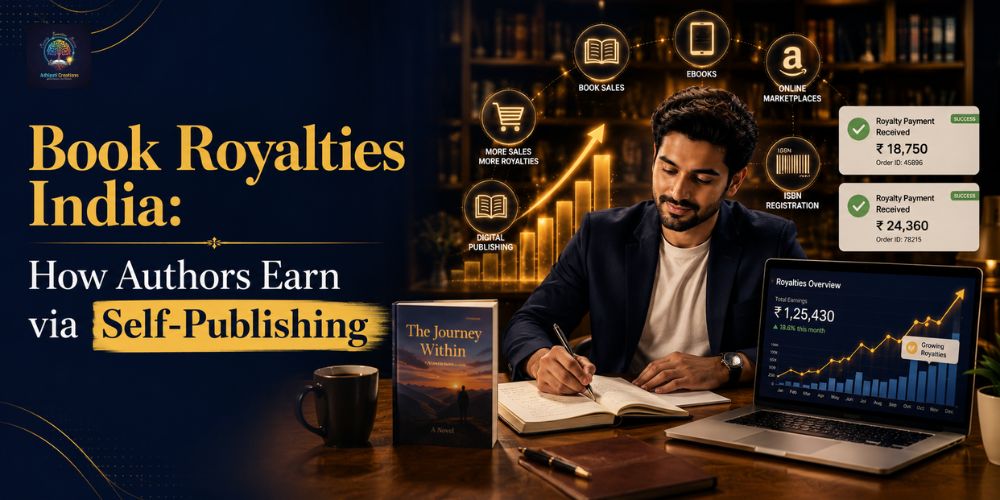
Self publishing has completely changed the way Indian authors think about writing and earning money from their books. A few years ago, getting published meant knocking on the doors of traditional publishing houses, waiting months for a reply, and often settling for royalty rates as low as 7–10%. Today, self publishing has flipped that equation. Indian authors are now earning higher royalties, retaining creative control, and building sustainable income streams directly from their books.
If you're an Indian author wondering how book royalties work in the self publishing world, or trying to understand how to maximize your earnings, this comprehensive guide from Adhipati Creations explains everything you need to know in simple language.
From understanding royalty percentages and publishing platforms to choosing the right pricing strategy and avoiding common mistakes, this guide will help you build a profitable self publishing journey.
Self publishing allows Indian authors to retain creative control, earn significantly higher royalties, and build long-term income from their books.
What Are Book Royalties?
Book royalties are the payments an author receives every time a copy of their book is sold. Whether your book is available as a paperback, hardcover, ebook, or audiobook, every sale generates royalty income according to the agreement between the author and the publishing platform.
In traditional publishing, the publisher generally pays the author only a small percentage of the book's selling price. Since the publisher bears the production, printing, marketing, and distribution expenses, authors usually receive royalties ranging between 7% and 15%.
Self publishing works differently. Instead of giving away a large portion of your earnings to a publishing house, authors publish independently or through professional Self Publishing Services, allowing them to retain ownership of their work and earn much higher royalty percentages.
Depending on the platform, pricing model, and book format, Indian self published authors can earn anywhere between 40% and 70% in royalties.
This difference is one of the biggest reasons why thousands of Indian writers are choosing self publishing instead of waiting for a traditional publishing contract.
The biggest advantage of self publishing isn't just faster publishing—it's the ability to keep a much larger share of every book sale.
Traditional Publishing vs Self Publishing Royalties
Understanding the difference between these two publishing models helps authors make better financial decisions before publishing their first book.
| Feature | Traditional Publishing | Self Publishing |
|---|---|---|
| Average Royalty | 7%–15% | 40%–70% |
| Ownership | Rights may be shared or transferred | Author retains complete ownership |
| Creative Control | Limited | Complete |
| Publishing Speed | Several months or years | Few weeks |
| Pricing Control | Publisher decides | Author decides |
| Royalty Potential | Lower | Higher |
While traditional publishing still appeals to some authors because of its established reputation, self publishing has become the preferred choice for writers who value ownership, flexibility, and better earning potential.
Higher royalties, faster publishing, and complete ownership have made self publishing the preferred choice for thousands of Indian authors.
Why Self Publishing Is Growing Rapidly in India
Over the last decade, India's self publishing industry has experienced remarkable growth. Today, aspiring writers no longer need to wait for a traditional publisher to approve their manuscript. Instead, they can publish independently while reaching readers across India and around the world.
Several factors have contributed to this rapid growth.
1. Access to Global Publishing Platforms
Indian authors can now publish directly through Amazon Kindle Direct Publishing (KDP), Notion Press, Pothi, and several other online publishing platforms without requiring a literary agent or publishing contract.
2. Lower Entry Barriers
Anyone with a completed manuscript can publish a professionally formatted book within a few weeks. There is no need to spend months sending proposals or waiting for acceptance letters.
3. Growing Digital Readership
The increasing popularity of smartphones, tablets, and eReaders has encouraged more readers to purchase ebooks and audiobooks, creating additional income opportunities for authors.
4. Better Royalty Structure
Unlike traditional publishing, self publishing enables authors to keep a much larger percentage of every sale, making writing a more sustainable source of income.
5. Complete Creative Freedom
Authors decide everything—from the title and cover design to pricing, formatting, and marketing strategy—without external interference.
Professional publishing companies like Adhipati Creations further simplify this journey by providing complete publishing support including editing, cover design & formatting, ISBN registration, publishing, distribution, and marketing assistance.
Self publishing has empowered Indian authors to publish globally, earn higher royalties, and build their own author brand without relying on traditional publishing houses.
If you're new to publishing, you may also find these resources helpful before publishing your first book:
- What is an ISBN and Why Authors Need It?
- Complete Guide to ISBN Registration in India
- Self Publishing Plans & Pricing
How Royalties Work in Self Publishing
Understanding how royalties are calculated is essential if you want to maximize your earnings as a self-published author. While royalty percentages are often advertised as 40%, 60%, or even 70%, the actual amount you receive depends on several factors such as the publishing platform, book format, pricing, printing costs, and distribution channel.
Before choosing where to publish, it's important to understand how each major self publishing platform calculates royalty payments.
Higher royalty percentages don't always mean higher earnings. Understanding how royalties are calculated helps authors make smarter publishing decisions.
1. Amazon Kindle Direct Publishing (KDP)
Amazon Kindle Direct Publishing (KDP) is one of the most popular self publishing platforms for Indian authors. It allows writers to publish ebooks and paperback books that are sold through Amazon marketplaces across the world.
For ebooks, Amazon generally offers two royalty options depending on your pricing strategy and distribution choices.
- 35% Royalty Option – Suitable for books priced outside Amazon's preferred pricing range or for authors who choose broader distribution options.
- 70% Royalty Option – Available for eligible ebooks that meet Amazon's pricing and formatting requirements. This option provides significantly higher earnings per sale.
For paperback books published through KDP Print, royalties are calculated after deducting the printing cost from the list price. The remaining amount is then shared with the author according to Amazon's royalty policy.
For many first-time Indian authors, Amazon KDP remains one of the easiest ways to reach readers across India and international markets.
Amazon KDP gives independent authors global reach while offering some of the highest royalty opportunities available in self publishing.
2. Notion Press
Notion Press is one of India's leading self publishing platforms, offering publishing solutions for both print and digital books. It is particularly popular among first-time authors because of its easy publishing process and multiple publishing packages.
Royalty earnings vary depending on the selected publishing plan and the channel through which the book is sold. In many cases, authors earn between 40% and 70% of the net revenue, especially for books sold through direct online channels.
Authors should carefully review the publishing package and royalty terms before finalizing their agreement.
Always compare publishing plans carefully—royalty percentages, distribution options, and included services can differ significantly between packages.
3. Pothi.com
Pothi.com is another popular self publishing platform in India that provides authors with greater flexibility over pricing and profit margins.
Unlike many fixed royalty models, Pothi allows authors to decide how much profit they want to earn above the printing cost. This gives writers more control over their earnings while allowing them to adjust prices according to market demand.
Authors publishing educational books, novels, poetry collections, and academic books often appreciate the flexibility that Pothi offers.
Platforms that allow authors to control pricing also give them greater flexibility in maximizing royalty income.
4. Audiobooks and Audible
The audiobook market in India has grown rapidly over the last few years. As more readers prefer listening to books during travel and daily activities, audiobooks have become another valuable source of royalty income.
Platforms such as Audible allow authors to publish audiobook editions of their work. Depending on the publishing agreement and distribution model, authors may earn royalties of up to 40% on audiobook sales.
Publishing your book in multiple formats—including paperback, ebook, and audiobook—helps create multiple revenue streams instead of depending on a single source of income.
Publishing your book in multiple formats increases your chances of reaching more readers and earning higher overall royalties.
Factors That Affect How Much Royalty You Earn
Your royalty percentage alone does not determine how much money you actually earn. Several important factors influence your final royalty income.
1. Book Pricing
Pricing your book correctly is one of the biggest factors affecting royalty earnings. Pricing too high may discourage readers, while pricing too low may reduce your overall income and make the book appear less valuable.
Many successful Indian self-published authors price their ebooks between ₹99 and ₹299, while paperback editions are commonly priced between ₹250 and ₹500, depending on the genre, page count, and target audience.
The right pricing strategy balances reader affordability with long-term royalty growth.
2. Book Format
The format you choose directly impacts your royalty earnings.
- Ebooks generally offer the highest royalty percentages because there are no printing or shipping costs.
- Paperback books involve printing expenses, reducing the final royalty per copy.
- Hardcover books usually have higher production costs but can command premium pricing.
- Audiobooks create an additional revenue stream while reaching a completely different audience.
Publishing in multiple formats allows authors to diversify their income while serving different reader preferences.
3. Platform Fees and Distribution Costs
Every publishing platform follows its own pricing model. Some charge upfront publishing fees, while others deduct a percentage from every sale or subtract printing and distribution costs before calculating royalties.
Before publishing your manuscript, always understand exactly how each platform calculates your royalty payments.
If you're planning to publish professionally, comparing the available Publishing Plans & Pricing can help you choose the most suitable publishing solution for your goals.
Understanding platform fees before publishing prevents unexpected deductions from your royalty earnings.
4. Marketing and Book Visibility
Even the highest royalty percentage won't help if your book doesn't sell. Marketing plays a crucial role in determining how much royalty income you actually earn. Successful self-published authors don't just publish their books—they actively promote them to reach more readers.
Effective book marketing can include:
- Social media promotion on Instagram, Facebook, and LinkedIn.
- Amazon Ads for increased product visibility.
- Book launch campaigns and author interviews.
- Email newsletters and reader communities.
- Book reviews from bloggers and influencers.
- Personal author websites and blogs.
Professional Book Marketing & Promotion Services can help authors improve visibility, increase book sales, and ultimately generate higher royalty income over time.
Royalties grow when book sales grow, and consistent marketing is the key to increasing long-term sales.
5. Genre and Reader Demand
Some book genres naturally generate higher sales because of stronger reader demand. While every well-written book has the potential to succeed, understanding market trends helps authors make informed publishing decisions.
Popular genres in India's self-publishing market include:
- Self-help and personal development
- Business and entrepreneurship
- Fiction and romance
- Mystery and thriller novels
- Academic and educational books
- Poetry collections
- Children's books
Choosing a genre with consistent demand, combined with professional publishing and marketing, can significantly improve royalty potential.
Quality content combined with market demand creates the strongest foundation for long-term royalty earnings.
Step-by-Step: How Indian Authors Can Maximize Royalty Income
Publishing a book is only the beginning. Authors who consistently earn royalties usually follow a structured publishing and marketing strategy. Here are the most effective steps to maximize your royalty income.
Step 1: Choose the Right Publishing Partner
Your publishing partner plays a major role in your book's success. A professional publishing company ensures your manuscript is edited, professionally designed, properly formatted, and distributed through trusted online platforms.
Adhipati Creations provides complete publishing support including editing & proofreading, cover design & formatting, ISBN registration, publishing, distribution, and promotional guidance to help authors maximize both quality and earnings.
The right publishing partner doesn't just publish your book—they help maximize its long-term earning potential.
Step 2: Read the Royalty Agreement Carefully
Before signing with any publishing platform or self-publishing company, carefully review the royalty agreement.
Pay special attention to:
- Royalty percentage.
- Payment schedule.
- Minimum payout amount.
- Exclusive or non-exclusive publishing rights.
- Distribution channels included.
- Any hidden service charges.
Understanding these terms in advance helps avoid misunderstandings later.
Always understand your royalty agreement before publishing—clear terms today prevent future disputes.
Step 3: Publish in Multiple Formats
Don't limit your manuscript to a single format. Publishing your book as an ebook, paperback, hardcover, and audiobook allows you to reach different types of readers while creating multiple income streams.
Many successful authors earn royalties simultaneously from digital editions, printed copies, and audiobook platforms.
- Ebook
- Paperback
- Hardcover
- Audiobook
Multiple book formats create multiple royalty streams from a single manuscript.
Step 4: Price Your Book Strategically
Pricing directly affects both sales volume and royalty income. Instead of choosing a random price, research similar books in your genre and understand your target audience.
A competitive price encourages more readers to purchase your book while maintaining healthy royalty margins.
Remember, earning slightly less per copy while selling significantly more copies often results in higher overall royalty income.
Smart pricing increases both sales volume and long-term royalty earnings.
Step 5: Distribute Across Multiple Platforms
Publishing exclusively on one platform may limit your potential audience. Wider distribution increases discoverability and gives readers more options for purchasing your book.
Many authors choose to distribute through:
- Amazon
- Flipkart
- Online bookstores
- Institutional bookstores
- Direct author websites
Professional Self Publishing Services can simplify multi-platform distribution while ensuring your book reaches a larger audience.
The more places your book is available, the greater your opportunity to generate consistent royalty income.
Step 6: Build Your Author Brand
Successful self-published authors don't just market one book—they build an author brand. Readers who enjoy one of your books are far more likely to purchase your future releases if they recognize your name and trust your work.
Building an author brand helps create a loyal audience while reducing your dependence on marketplace algorithms.
Some effective ways to build your author brand include:
- Creating an author website.
- Sharing writing updates on Instagram, Facebook, and LinkedIn.
- Starting a YouTube channel or podcast related to your niche.
- Publishing valuable content through blogs.
- Building an email newsletter to stay connected with readers.
- Participating in book fairs, literary events, and author interviews.
Authors with an engaged audience generally enjoy stronger book launches, better reader engagement, and more consistent royalty income over time.
Your book builds your reputation, but your personal brand builds long-term royalty income.
Step 7: Track Your Royalty Reports Regularly
Most self-publishing platforms provide detailed dashboards where authors can monitor book sales, royalties, reader locations, and payment history.
Reviewing these reports regularly helps you understand:
- Which books are selling the most.
- Which formats generate the highest income.
- Which countries or regions produce the most sales.
- Whether pricing adjustments improve revenue.
- Which marketing campaigns generate better results.
Authors who regularly analyze their sales reports can make better decisions about pricing, promotions, advertising, and future book launches.
Successful authors don't guess—they use royalty reports and sales data to make smarter publishing decisions.
Common Mistakes Indian Authors Make with Royalties
Even experienced writers sometimes make mistakes that reduce their royalty earnings. Understanding these common pitfalls can help you protect your income and avoid unnecessary setbacks.
1. Signing Exclusive Agreements Without Understanding the Terms
Some authors agree to exclusive publishing contracts without fully understanding how these agreements affect future publishing opportunities.
Exclusivity may limit where you can sell your book or prevent you from distributing it through additional platforms. Always read the agreement carefully before signing.
Never sign a publishing agreement until you clearly understand your royalty rights and distribution options.
2. Ignoring Hidden Publishing Costs
Some publishing companies advertise attractive royalty percentages but charge additional fees for services such as editing, formatting, cover design, ISBN registration, or distribution.
Before choosing any publishing company, understand exactly what services are included in the package.
You can compare different publishing options through the Publishing Plans & Pricing page before making your decision.
3. Underpricing the Book
Many first-time authors believe pricing their book very low will automatically generate more sales. However, pricing your book too cheaply can reduce your overall royalty income while also affecting the perceived value of your work.
A well-researched pricing strategy usually performs better than simply offering the lowest price.
Readers often associate extremely low prices with lower quality. Strategic pricing builds both credibility and profitability.
4. Ignoring Payment Schedules
Every publishing platform follows its own royalty payment cycle. Some pay monthly, while others release payments every quarter or after a fixed waiting period.
Understanding these schedules helps authors plan their finances more effectively and avoid confusion regarding expected payments.
5. Publishing Without Professional Editing
A poorly edited manuscript often receives negative reviews, reducing reader trust and long-term sales.
Professional Editing & Proofreading Services help improve readability, eliminate errors, and present your work professionally before publication.
Similarly, investing in quality Book Cover Design & Formatting increases the likelihood of attracting potential readers.
Professional editing isn't an expense—it's an investment that protects your book's reputation and future royalty income.
Why Choose Adhipati Creations for Your Self Publishing Journey?
Choosing the right publishing partner can make a significant difference in both the quality of your book and the royalties you earn over time.
At Adhipati Creations, we believe authors should retain complete ownership of their work while receiving professional support throughout the publishing journey.
Our publishing solutions include:
- Professional manuscript evaluation.
- Editing & proofreading.
- Custom cover design & interior formatting.
- ISBN registration & distribution support.
- Paperback and ebook publishing.
- Publishing across leading online bookstores.
- Book marketing & promotional support.
- Dedicated author assistance throughout the publishing process.
Whether you're publishing your first novel, a business book, poetry collection, children's book, or academic title, our experienced publishing team helps you transform your manuscript into a professionally published book while maximizing its long-term earning potential.
Publishing should create lasting opportunities for authors—not just launch a book. That's the philosophy behind every project at Adhipati Creations.
Tax and Legal Considerations for Royalty Income in India
Many first-time authors focus entirely on publishing their book and overlook the financial and legal aspects of earning royalty income. Understanding these requirements early can help you avoid tax issues and manage your publishing income more efficiently.
If you plan to earn regular income through self publishing, it's a good idea to understand how royalties are taxed, what documents you may need to submit, and how to maintain proper financial records.
Publishing your book is only the beginning. Managing your royalty income correctly is equally important for long-term success.
1. Royalty Income Is Taxable
Royalty income earned by Indian authors is generally taxable under the applicable provisions of the Income Tax Act. Depending on your individual circumstances, royalty earnings may be treated as income from your profession or another applicable income category.
If publishing becomes a regular source of income, maintaining proper records of your earnings and expenses becomes increasingly important.
Understanding your tax responsibilities helps you manage your publishing income more effectively and avoid unnecessary complications.
2. W-8BEN Form for International Platforms
If you publish through international platforms such as Amazon Kindle Direct Publishing (KDP), you may be required to submit a W-8BEN form.
This document helps Indian authors claim the benefits available under applicable tax treaties and may reduce the withholding tax deducted from royalty payments made by overseas platforms.
Authors publishing internationally should review the latest platform requirements before completing the registration process.
3. GST Considerations
Authors who only earn royalty income may have different tax obligations compared to those who also provide publishing-related services such as editing, ghostwriting, consulting, or book design.
Since taxation rules may vary based on individual circumstances, consulting a qualified Chartered Accountant before making financial decisions is always advisable.
Professional tax advice helps authors stay compliant while focusing on growing their publishing career.
4. Maintain Proper Financial Records
Keeping organized records makes it much easier to manage your publishing business and prepare financial documents whenever required.
Maintain records of:
- Royalty payment statements.
- Sales reports from publishing platforms.
- Publishing invoices.
- Editing and design expenses.
- Marketing expenses.
- ISBN registration and publishing costs.
Accurate financial records help you understand the profitability of each book while simplifying future tax filings.
5. Consider Registering Your Publishing Business
Authors earning substantial income from publishing sometimes choose to operate as a sole proprietorship or other suitable business structure.
This may provide operational benefits depending on the author's publishing activities and long-term business goals. Professional financial advice should always be obtained before making such decisions.
Treat your writing like a business, and your books can become a long-term source of sustainable income.
Real-World Example: How Royalty Income Can Grow
Let's look at a simple example to understand how self publishing royalties can accumulate over time.
Suppose an Indian author publishes a self-help ebook priced at ₹199 through Amazon KDP using an eligible higher royalty option.
If the ebook sells 500 copies over a few months, the total royalty earned can become substantial. Now imagine the same author also publishes a paperback edition priced at ₹350 and sells another 300 copies.
By publishing in multiple formats and maintaining consistent sales, the combined royalty income can exceed ₹1 lakh, demonstrating how self publishing can become a meaningful source of recurring income.
Actual royalty earnings always depend on pricing, platform policies, distribution costs, and the number of books sold.
One manuscript can generate multiple income streams when published as an ebook, paperback, hardcover, and audiobook.
Final Thoughts
Self publishing has completely transformed the opportunities available to Indian authors. Instead of waiting months or even years for approval from traditional publishing houses, writers can now publish professionally, retain complete ownership of their work, and earn substantially higher royalties.
However, maximizing royalty income is about much more than simply publishing a book. Success depends on choosing the right publishing partner, pricing your book strategically, publishing across multiple formats, marketing consistently, and understanding how royalty payments actually work.
Whether you're writing your first novel, a business book, a poetry collection, an academic title, or a self-help guide, investing in professional publishing services can significantly improve both your book's quality and its long-term earning potential.
At Adhipati Creations, we help authors at every stage of their publishing journey—from manuscript editing and professional formatting to ISBN registration, publishing, distribution, and book marketing.
Our mission is simple: to help Indian authors publish confidently, retain complete ownership of their work, and build sustainable royalty income through professional self publishing.
Every successful author begins with a manuscript. The right publishing strategy transforms that manuscript into long-term royalty income and a lasting author brand.
Related Publishing Resources
If you're planning to publish your book or want to understand the publishing process in more detail, these resources may help:
- Self Publishing Services
- Editing & Proofreading Services
- Book Cover Design & Formatting
- ISBN Registration & Distribution
- Book Marketing & Promotion Services
- Publishing Plans & Pricing
- What is an ISBN and Why Authors Need It?
- How to Get an ISBN Number in India
- Read More Publishing Blogs
Ready to Start Earning Better Book Royalties?
Whether you're publishing your first book or looking to maximize the earnings from your next title, Adhipati Creations provides complete self publishing support—from manuscript evaluation and professional editing to cover design, ISBN registration, publishing, distribution, and marketing.
Your book deserves more than publication—it deserves readers, recognition, and the royalties you've worked hard to earn.