Having the Book is Not Enough
Let’s be honest for a second. Buying a gym membership doesn't give you six-pack abs. Going to the gym and working out correctly does.
The same logic applies to your studies. You might have the best books in the world you might have the entire collection on your shelf but if you don't know how to use them effectively, they are just paper.
Many students make the mistake of reading NCERT MADE EASY exactly like they read a novel. They start from page 1, read till the end, and think, "Chalo, chapter khatam."
Wrong approach.
To crack exams like NEET, JEE Main, CUET or CBSE Boards, you don't just need to read; you need to absorb. You need a strategy that locks concepts into your long-term memory so that even in the high-pressure environment of the exam hall, you don't forget the answer.
In this detailed guide, we will share the "Active Decoding Method" a step-by-step strategy to study using NCERT MADE EASY that will boost your retention and help you score that dream rank.
Table of Contents
Phase 1: The Pre-Study Warm-up (Setting the Stage)

Before you dive into the heavy concepts of Physics or the complex cycles of Biology, you need to warm up your brain.
1. The "5-Minute Scan"
Don't start reading line-by-line immediately.
- Open your NCERT MADE EASY book (let's say, Class 11 Biology).
- Flip through the chapter for just 5 minutes.
- Look at the Headings: What is this chapter about? Is it Cell Division? Is it Plant Kingdom?
- Look at the Flowcharts: Just glance at the diagrams.
Why do this? This creates a "map" in your brain. When you actually start studying, your brain already knows where to file the information. Aapka dimaag shock nahi hota, woh ready rehta hai.
Phase 2: The Core Study Session (The "Decoder" Technique)
This is the most critical part. This is where you actually learn. We call this the "Side-by-Side" Strategy.
Step 1: Keep Both Books Open
- Place your original NCERT textbook on the left and your NCERT MADE EASY book on the right.
- Why? Because your final exam will be based on NCERT text. You cannot abandon the original book. You need to master it using the helper book.
Step 2: Read the "Hard" Text First
- Read one paragraph from the original NCERT.
- If you understand it fully, great!
- But usually, you will face a complex sentence. For example, in Class 12 Physics, Electrostatics definitions can be very confusing.
- Struggle for 30 seconds. Try to understand it.
Step 3: Switch to the "Easy" Text
- Now, immediately look at the corresponding section in NCERT MADE EASY.
- Read the simplified explanation.
- Read the bullet points.
- Look at the breakdown of the concept.
- The Magic Moment: Suddenly, the confusion clears up. You realize, "Oh! This is what the author meant!"
- This transition from Confusion -> Clarity creates a very strong memory pathway. You will never forget that concept because you struggled with it first, then solved it.
Step 4: Highlight the "Hidden Gems"
- NCERT MADE EASY contains special boxes labeled "Note" or "Important."
- These are points that are often hidden in the massive paragraphs of the original book.
- Take a highlighter and mark these specific points in your original NCERT book too.
- Now, your original book is also becoming an "easy" book for future revision.
Phase 3: Subject-Specific Strategies
Every subject requires a different approach. You cannot study History like Mathematics. Similarly, you cannot study Biology like Physics.
Strategy for Biology: The Visual Imprint
Biology is not just theory; it is a process. Digestion is a process. Genetics is a process.
- The Mistake: Students try to memorize the text of the process.
- The Made Easy Way: Open Class 11 Biology or Class 12 Biology.
- Focus entirely on the Flowcharts.
- Cover the text with your hand. Look at the flowchart and try to narrate the story of the process in your own words.
- If you can explain the flowchart, you have mastered the chapter.
Strategy for Physics: The "Why" Behind the "What"
In Physics, memorizing the formula $F=ma$ is useless if you don't know where to apply it.
- The Mistake: Jumping straight to numericals.
- The Made Easy Way: Use Class 11 Physics Part 1 to understand the derivation.
- NCERT MADE EASY breaks down derivations step-by-step. Don't just read the steps—write them down.
- Understanding the logic of the derivation helps you solve tough questions in JEE/NEET because you know the origin of the formula.
Strategy for Chemistry: The Exception Hunter
Chemistry is full of exceptions. Iska trend increasing hai, but uska decreasing hai.
- The Mistake: Getting confused by mixing up trends.
- The Made Easy Way: Use the Summary Tables provided in Class 11 Chemistry and Class 12 Chemistry.
- Compare elements side-by-side using the tables.
- The book explicitly highlights exceptions in "Alert Boxes." Make a separate notebook just for these exceptions.
Phase 4: The Revision Game (Active Recall)
You studied today. You understood everything. But will you remember it after 10 days?
Science says you will forget 70% of it within 24 hours if you don't revise. Here is how to use NCERT MADE EASY for super-fast revision.
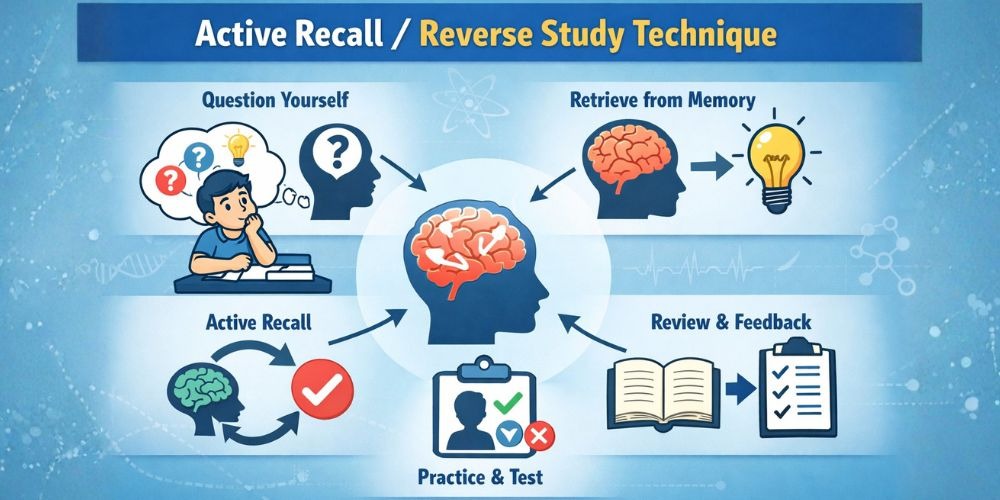
The "Reverse Study" Technique
When revising a chapter after a week:
- Do NOT read the paragraphs.
- Open NCERT MADE EASY and look only at the Bold Headings and Diagrams.
- Ask yourself: "What is written under this heading?"
- Try to answer in your mind.
- If you can't remember, only then read the bullet points below it.
- This method, known as Active Recall, is far superior to passive re-reading.
The "Night Before Exam" Saver
One day before the exam, you cannot read thick books.
- Use NCERT MADE EASY as your "Short Notes."
- The book is already concise. Read only the summary points and flowcharts.
- You can revise the entire syllabus of Class 12 Physics in just 4-5 hours using this book, which is impossible with the original textbook.
Phase 5: Testing Your Knowledge
You have studied. You have revised. Now, are you ready for the exam? Don't guess. Test it.
- NCERT MADE EASY builds your concepts, but to apply them, you need practice.
- Once you finish a chapter from this book, immediately solve questions.
- We recommend using the Self Assessment Kits available on Adhipati Creations.
- For example, if you just finished a Biology chapter, pick up the Med Ace NEET UG Self Assessment Kit.
- If you can solve 80% of the questions correctly, your study method was successful. If not, go back to the Made Easy book and check the "Note" points again.
Common Mistakes to Avoid ❌
Even with the best book, you can fail if you do these things:
- Ignoring the Diagrams: In biology, diagrams are questions. NCERT MADE EASY simplifies diagrams, but you must still practice drawing/labeling them.
- Skipping the "Intro" Paragraphs: NTA often asks questions from the scientist's history or introduction given at the start of units. This book covers them - don't skip them!
- Using it as a "Shortcut" without Understanding: Don't just memorize the simplified points. Use them to understand the concept. Ratta will fail you in JEE/NEET; understanding will save you.
Final Verdict: Work Smart, Not Just Hard
Toppers don't have 48 hours in a day. They have the same 24 hours as you. The difference is in their tools and their technique.
They don't waste 3 hours trying to decode one difficult page. They use resources like NCERT MADE EASY to understand it in 15 minutes and spend the remaining time practicing questions.
That is the Smart Study method.
So, are you ready to change the way you study? Stop struggling with complex language. Start decoding your syllabus today.
Grab Your Copies Now
Ensure you have the latest edition for the best results. Click the links below to order directly from Adhipati Creations:
For Class 11 Students:
For Class 12 Students: