

If you have been feeling tired, stressed, or mentally exhausted while studying…
If your mind wanders even when the books are open…
If you are trying hard, yet your performance does not improve…
You are not alone.
Thousands of NEET, JEE, CUET and CBSE students experience study burnout every year.
Burnout is not about being weak, lazy or undisciplined.
It happens because preparing for competitive exams demands long hours, emotional pressure, and high expectations and most students are never taught how to manage their energy along with their time.
So yes — your struggle is real. And it is valid.
The good news? Burnout is NOT permanent.
There are clear strategies to avoid it, recover from it, and continue your preparation with confidence.
To support students in this journey, Adhipati Creations provides thoughtfully-designed study planners, question banks, structured revision guides, and mock test series that help you study smart, not just hard - minimizing stress while maximizing results.
This blog will help you understand:
- ✅ What burnout actually is
- ✅ Why it happens
- ✅ How to recognize it early
- ✅ Practical steps to avoid it
- ✅ How to recover when burnout strikes
- ✅ And how to study consistently without exhaustion
Let’s begin.

Table of Contents
What Exactly Is Burnout?
Burnout is not just being tired.
It is a state of mental and emotional exhaustion where:
- You want to study, but your brain refuses to concentrate.
- You feel irritated, low-energy, or frustrated.
- Even simple tasks feel overwhelming.
Common Signs of Burnout:
| Sign | Example |
|---|---|
| Brain Fog | Reading the same line multiple times but not understanding |
| Lack of Motivation | Feeling “What’s the point? Nothing improves.†|
| Irritation or Mood Swings | Small things make you angry or emotional |
| Tiredness Even After Rest | Body feels heavy, mind feels numb |
| Decreased Academic Performance | You know concepts but can’t recall them |
Tip Box:
If you have read the same paragraph 3 times and still don’t get it - Your brain needs rest, not more pressure.
Burnout reduces learning efficiency and ignoring it can slow down your progress much more than taking a break.
Why Burnout Happens to Students
Burnout doesn’t happen overnight.
It builds slowly, when stress is constant and unchecked.
Here are the real reasons students burn out:
1. Unrealistic Study Schedules
Trying to study 10–14 hours every day is not sustainable.
Even toppers do not study at that intensity daily.
2. Fear of Failure
Constant thoughts like:
- What if I don't score well?
- What will everyone think?
- Will my future be ruined?
This emotional pressure drains mental energy.
3. Comparison with Others
Social media, coaching groups, toppers’ screenshots these create self-doubt and stress.
4. Lack of Rest or Physical Activity
Studying continuously without breaks exhausts the brain, affecting memory and focus.
5. No Study Structure
When you don't know what to study today, your mind gets overwhelmed and shuts down. Using a structured study plan helps navigate this.
7 Smart Ways to Avoid Burnout (Backed by Science & Toppers)
Let us go step-by-step through the most effective strategies used by top rankers and emotional wellness experts.
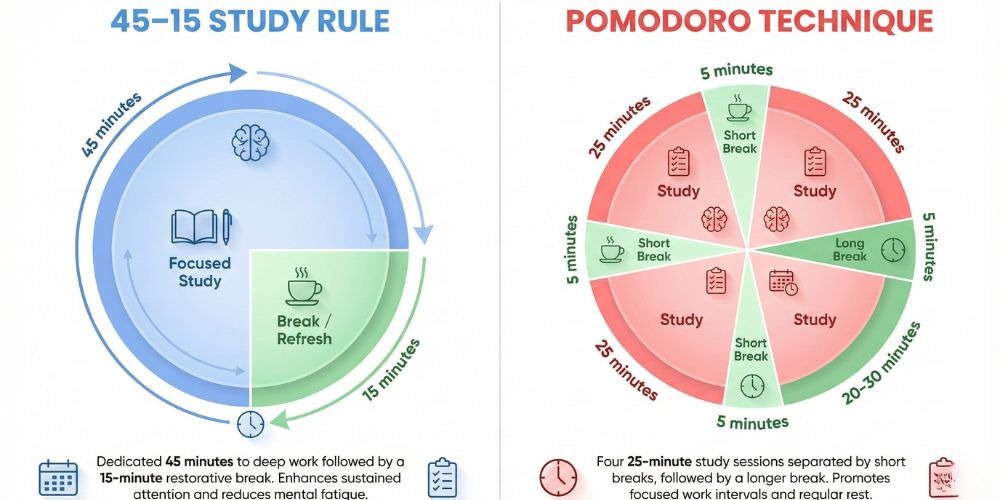
1. Study Smart, Not Long
Most students believe: The more hours I study, the better I will perform.
This is wrong.
Your brain learns better in sharp, focused sessions, not long forced sessions.
Use Focused Study Cycles:
| Cycle | Format |
|---|---|
| 45-15 Method | 45 minutes study + 15 minutes break |
| 90-30 Method | 90 minutes deep focus + 30 minutes recharge |
Breaks help your brain:
- Reset attention
- Improve memory recall
- Reduce stress buildup
2. Include Micro-Breaks
Your brain cannot process continuous intake of information.
Micro-breaks help your mind absorb, store, and recall better.
After every study block:
- Stand up
- Stretch your shoulders, neck, and back
- Take deep breaths
- Drink water
This makes your brain ready for the next session instead of drained.
Bonus: Micro-breaks reduce headaches and eye strain.
3. Sleep Without Guilt
Some students proudly say: I sleep only 4 hours. I am serious about my goals.
This is not seriousness it is self-destruction.
During sleep:
- Your brain converts studied information into memory
- Your concentration power resets
- Your emotional balance is restored
Without sleep, even 10 hours of study becomes zero output.
Ideal Sleep Duration: ✅ 7 hours per night (minimum)
This one habit alone can improve:
- Retention
- Speed
- Concentration
- Confidence
- Exam performance
4. Switch Subjects Smartly
Studying one heavy subject for many hours leads to mental overload.
Instead, alternate between:
| Heavy Subjects | Lighter Subjects |
|---|---|
| Physics / Maths / Organic Chemistry | Biology diagrams / English / NCERT reading |
This keeps your brain fresh and flexible.
5. Exercise or Walk Daily
Movement is medicine.
10–30 minutes of:
- Walking
- Yoga
- Cycling
- Stretching
Releases endorphins - the chemicals that:
- Reduce stress
- Boost mood
- Improve concentration
This is why almost every topper works out daily.
6. Reward Small Wins
When you appreciate yourself, your brain loves studying.
Reward examples:
- After finishing a tough chapter - eat your favorite snack
- After completing a mock test - watch one episode guilt-free
- After sticking to your routine for a week - take a planned break day
This replaces stress with motivation.
7. Use Structured Study Materials
Unorganized notes = confusion + stress
Organized study tools = clarity + confidence
This is where Adhipati Creations helps.
Our tools reduce burnout by reducing confusion:
| Tool | Purpose |
|---|---|
| Smart Revision Guides | Quick memory refresh to avoid re-reading heavy books |
| Mock Test Series | Gradual pressure training - builds confidence |
| Chapterwise Question Banks | One chapter at a time - No overwhelm |
Internal Links:
How to Reset When You Feel Burned Out
Even after doing everything right, burnout can still happen and that’s okay.
Here is how to bounce back stronger:
✅ Take One Full Rest Day Every 10–15 Days
This resets mental fatigue.
✅ Avoid Guilt
Rest is not "wasted time."
Rest is recovery time.
✅ Write Down Your Achievements
This reconnects you with your progress.
✅ Talk to a Mentor / Parent
Sharing reduces emotional pressure.
✅ Repeat Your “ Whyâ€
Why are you preparing?
What dream are you chasing?
Whose effort are you honoring?
Your “why†revives your courage.
💬 Quote: Taking a break is not quitting - it’s recharging to come back stronger.
The Role of Balanced Study Resources
Burnout happens when study feels chaotic, unplanned, and directionless.
The right resources:
- Reduce confusion
- Provide structure
- Help you track progress
- Prevent mental overload
That’s why Adhipati Creations offers:
- ✅ Chapterwise Question Banks
- ✅ Daily Study Planners
- ✅ Rapid Revision Guides
- ✅ Mock Test Packs
- ✅ Performance Trackers
These tools make preparation:
- Simpler
- Lighter
- Clearer
- More confident
Stay on track without exhaustion using the complete Adhipati Creations Study Ecosystem.
Conclusion - Study Smart, Study Steady
Burnout does't mean you're weak.
It means you've been strong for too long without support.
Remember:
- You don't need extreme hard work.
- You don't need to study all day.
- You don't need to prove anything to anyone.
You only need to show up steadily - one day at a time.
Consistency - not exhaustion - creates toppers.
Protect your mind.
Prioritize rest.
Use structured tools.
Trust the process.
And your results will rise naturally.
✅ Ready to Study Without Stress?
Don't let burnout stop you. Get the right tools and start your disciplined, balanced journey today.