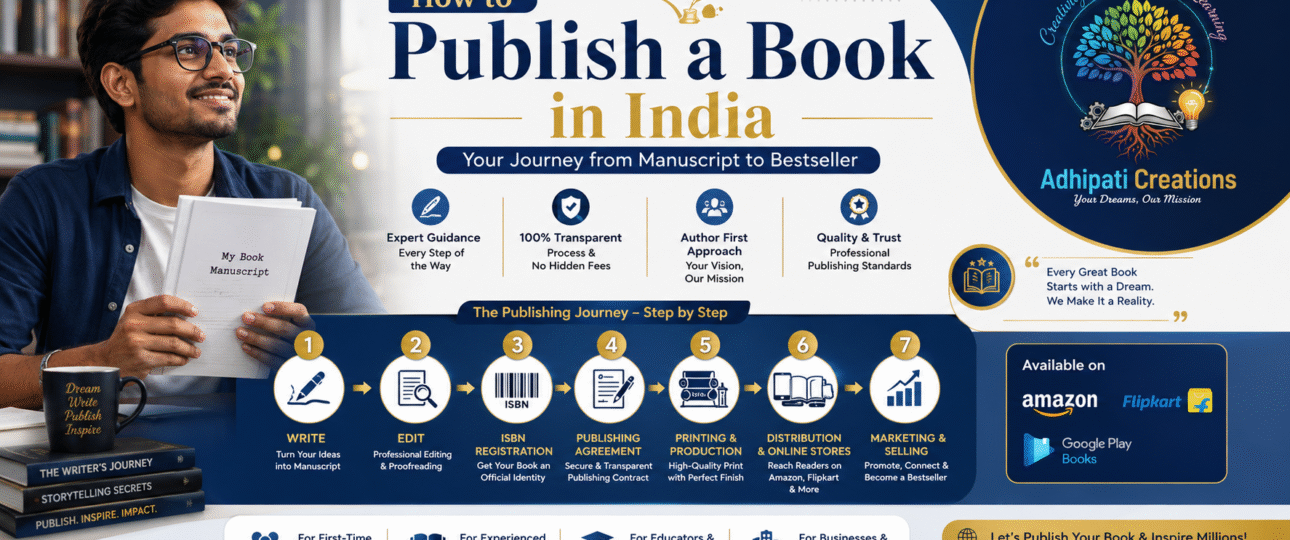
A step-by-step guide for aspiring Indian authors — from manuscript to marketplace, covering traditional publishing, self-publishing, Amazon KDP, ISBN registration, costs, royalties, and marketing.
By Adhipati Creations · 15 min read · 2,800+ words
Publishing a book in India in 2026 is more accessible than ever before. Whether you are a first-time author with a debut novel or a professional with expertise to share, this guide walks you through every step — clearly, honestly, and without unnecessary jargon.
STEP 1 Prepare Your Manuscript
Before you think about publishing platforms, literary agents, or cover designs, your manuscript must be ready. This is the single most important step in the entire process, and it is the one most first-time authors rush through.
A publication-ready manuscript involves three distinct stages of refinement:
- Structural or developmental editing — Evaluates the overall flow, pacing, coherence, and structure of your content. For fiction, this means plot arcs, character development, and narrative consistency. For non-fiction, it means logical argument progression and chapter cohesion.
- Copyediting — Line-by-line correction of grammar, syntax, sentence construction, word choice, tense consistency, and style.
- Proofreading — The final quality check that catches residual typos, formatting inconsistencies, punctuation errors, and layout issues before the file goes to print or upload.
Many Indian authors skip professional editing and proofreading to save costs. This is a mistake. Reader reviews mentioning poor editing can permanently damage your book's sales.
A professional editor typically charges ₹1 to ₹3 per word for copyediting, which is a worthy investment for a book you have spent months or years writing.
Once editing is complete, format your manuscript in Microsoft Word or Google Docs according to standard manuscript guidelines: Times New Roman or Garamond, 12pt font, double spacing, one-inch margins, and page numbers. This is the format most publishers and self-publishing platforms expect upon submission.
STEP 2 Choose Your Publishing Route
India's publishing ecosystem in 2026 offers three primary routes. Understanding the differences is crucial before you make a commitment.
| Factor | Traditional Publishing | Self-Publishing | Amazon KDP |
|---|---|---|---|
| Upfront Cost | ₹0 (publisher pays) | ₹15,000–₹1,50,000+ | ₹0 (free to upload) |
| Royalty Rate | 6–15% | 40–100% | 35–70% |
| Creative Control | Limited | Full | Full |
| Distribution | Wide (stores + libraries) | Depends on platform | Amazon India & global |
| Time to Publish | 1–3 years | 4–12 weeks | 24–72 hours |
| Rights | Publisher holds rights | You retain all rights | You retain all rights |
| Prestige | High | Growing | Growing |
There is no universally superior option. Your choice should depend on your goals: if you want maximum prestige and do not mind waiting, pursue traditional publishing. If you want speed, control, and higher royalties, self-publishing or KDP is the right path.
STEP 3 Traditional Publishing in India
Traditional publishing in India works broadly the same way as it does globally. You submit your manuscript (typically with a query letter and a synopsis) to literary agents or directly to publishers. If accepted, the publisher covers all production costs — editing, cover design, printing, and distribution — in exchange for a percentage of your royalties and partial ownership of your rights.
Top Traditional Publishers in India
| Category | Publisher | Description |
|---|---|---|
| Big Five India | Penguin Random House India | India's largest publisher. Accepts submissions through literary agents primarily. |
| Renowned House | HarperCollins India | Publishes fiction, non-fiction, and children's books. Strong retail distribution. |
| Literary Focus | Hachette India | Known for quality literary fiction and popular non-fiction titles. |
| Academic & General | Oxford University Press India | Ideal for academic, educational, and serious non-fiction manuscripts. |
| Mid-Size Publisher | Rupa Publications | One of the oldest Indian publishers. Open to direct manuscript submissions. |
| Independent | Speaking Tiger Books | Boutique publisher known for quality literary and translation works. |
Traditional publishers in India reject approximately 95–99% of unsolicited manuscripts. Rejection does not reflect the quality of your writing — it often reflects market timing, the publisher's current list, or simply that your book did not connect with a particular reader.
If you receive rejections, treat them as part of the process and keep submitting.
How to Submit to Traditional Publishers
- Research which publishers accept your genre. Not all publishers publish all types of books.
- Write a compelling query letter: one paragraph about the book, one about yourself, and one about the market.
- Prepare a synopsis (usually 1–2 pages) summarising your entire book including the ending.
- Check each publisher's submission guidelines carefully — they vary significantly.
- Submit to multiple publishers simultaneously (unless submission guidelines say otherwise).
- Wait. Response times range from 4 weeks to 6 months.
STEP 4 Self-Publishing in India
Self-publishing in India has undergone a dramatic transformation in India over the past decade. What was once considered a vanity option is today a legitimate, professional, and often financially superior publishing path. India now has a thriving ecosystem of self-publishing service providers that offer everything from editing to print-on-demand distribution.
Self-publishing in India lets you keep creative control, earn higher royalties, and reach readers globally — all on your own timeline.
Popular Self-Publishing Platforms in India (2026)
| Category | Platform | Description |
|---|---|---|
| Global + India | Amazon KDP | Free to publish ebooks and paperbacks. 35–70% royalties. Largest reader base. |
| India-Focused | Notion Press | Chennai-based. Packages include editing, cover design, and distribution services. |
| India-Focused | Pothi.com | Pioneer of print-on-demand in India. Strong domestic distribution. |
| India-Focused | White Falcon Publishing | Full-service self-publishing with distribution to 150+ countries. |
| Global Distribution | IngramSpark | Best for authors who want physical books in bookstores worldwide. |
| Ebook Distribution | Draft2Digital | Distributes your ebook to Apple Books, Kobo, Barnes & Noble, and more — for free. |
Indie Publishing vs. DIY Self-Publishing
A common source of confusion among Indian authors is the distinction between indie publishing companies and pure self-publishing. In the pure DIY model, you handle everything yourself — editing, formatting, ISBN registration, cover design, and uploading. In the indie publishing model, a service company handles these tasks for you while you retain full rights and royalties. Think of it as hiring a team rather than doing it alone.
STEP 5 Amazon KDP — Publishing on Kindle
Amazon Kindle Direct Publishing (KDP) is by far the most popular route for Indian authors seeking global reach without upfront costs. It allows you to publish both ebooks (for Kindle devices and apps) and print-on-demand paperbacks.
1 Create a KDP Account
Sign up at kdp.amazon.com with your Amazon account. Add your bank details for royalty payments and PAN for tax purposes.
2 Prepare Your Files
KDP accepts .docx or .epub for ebooks and a print-ready PDF for paperback. Cover must be separate from interior file.
3 Set Metadata & Keywords
Choose 2 BISAC categories and 7 keywords carefully — these determine your discoverability in Amazon search.
4 Choose Your Price & Royalty
Ebooks priced ₹99–₹799 earn 35% royalty. Ebooks priced ₹800–₹4,999 earn 70% royalty on Amazon India.
5 Publish and Go Live
After submission, Amazon reviews your book in 24–72 hours. Your book goes live on Amazon.in and global marketplaces.
6 Enroll in KDP Select (Optional)
Exclusive to Amazon for 90 days. Gives access to Kindle Unlimited readers and promotional tools like Countdown Deals.
STEP 6 Getting an ISBN in India
An ISBN (International Standard Book Number) is the 13-digit unique identifier that allows your book to be stocked by libraries, listed in bookstores, and tracked across distribution systems globally. In India, the process is well-established and government-managed.
Who Issues ISBNs in India?
ISBNs in India are issued by the Raja Rammohun Roy National Agency for ISBN, which operates under the Ministry of Education, Government of India. The official portal is isbn.gov.in. ISBN Registration in India itself is free of charge for Indian publishers and authors.
Key Facts About ISBN in India
Each format of your book (paperback, hardcover, ebook) requires a separate ISBN. If you publish in all three formats, you need three ISBNs. Applications typically take 7–15 days when submitted correctly, though incomplete applications can extend processing to 3–6 weeks.
How to Apply for an ISBN
- Visit isbn.gov.in and create a publisher/author account.
- Submit your valid government photo ID (Aadhaar or PAN card).
- Fill in your book's metadata: title, author name, language, genre, format, and expected publication date.
- Submit the application. The agency will verify and assign your ISBN.
- Once received, include your ISBN on the copyright page and generate a barcode for the back cover.
Note on Legal Deposit
After receiving your ISBN and publishing your book, you are legally required to send printed copies of your book to designated national libraries in India. This is called a "legal deposit." Practically, this adds a modest cost (approximately ₹1,500–₹2,000 for printing and courier charges). Most self-publishing service companies handle this as part of their packages.
STEP 7 Book Cover Design and Interior Formatting
The cover is your book's most powerful marketing tool. Professional book cover design and formatting services can significantly improve conversion rates.
Cover Design Guidelines
- Hire a professional book cover designer (not a general graphic designer). They understand genre conventions, typography hierarchy, and thumbnail legibility — critical for online retail.
- Your cover must work at thumbnail size (the size it appears in Amazon search results). Check by viewing it at 150px wide.
- Ensure the back cover includes your author bio, book blurb, ISBN barcode, and price (if printing in India).
Book cover design in India typically costs between ₹3,000 and ₹20,000 depending on the designer's experience.
Interior Formatting
Interior formatting transforms your edited manuscript into a professionally typeset file suitable for printing or digital distribution. For print books, this means proper margins, chapter openers, running headers, page numbers, and print-ready PDF export. For ebooks, this means clean .epub files that render correctly across Kindle, Apple Books, and Kobo devices.
Tools commonly used for interior formatting include Microsoft Word (basic), Vellum (Mac only, excellent for fiction), Affinity Publisher, and Adobe InDesign (professional standard). If you are not comfortable with formatting software, hiring a professional formatter costs approximately ₹2,000–₹8,000.
STEP 8 Printing and Distribution in India
Once your book is formatted and your cover is finalised, you need to decide how your physical book will be produced and delivered to readers.
Print-on-Demand (POD)
Print-on-demand is the dominant model for self-published Indian authors in 2026. Under this model, books are printed individually as orders come in — eliminating the need for upfront print runs, storage, or inventory management. Platforms like Amazon KDP, Pothi.com, and IngramSpark offer POD services in India.
Offset Printing
Offset printing is economical for large quantities (typically 500 copies or more). The per-unit cost drops significantly at higher quantities. This model makes sense if you are confident about selling a large volume and have storage space. Several commercial printers in Delhi, Mumbai, Chennai, and Ahmedabad offer competitive rates.
Distribution Channels in India
- Amazon.in — The single most important channel for Indian authors selling online.
- Flipkart — India's second-largest e-commerce platform with a significant books section.
- Crossword and Oxford Bookstores — Physical retail chains, accessible through publishing service providers or direct consignment.
- IngramSpark — Provides global physical distribution to bookstores in 150+ countries.
- Your own website — Direct sales via your author website yield the highest margins.
STEP 9 Marketing Your Book in India
Publishing your book is only the beginning. Strategic book marketing and promotional campaigns help readers discover your work. Without consistent marketing effort, even a well-written, professionally produced book will go unnoticed. Marketing is not optional — it is the difference between a book that sells and one that sits unread.
Before Launch (4–8 Weeks Prior)
- Build an author website with a blog, about page, and email signup form.
- Begin posting consistently on Instagram, LinkedIn, and X (Twitter) about your writing journey and the book's themes.
- Reach out to book bloggers, BookTok creators, and literary Instagram accounts (known collectively as BookStagram in India) for advance review copies.
- Set up a pre-order page on Amazon if publishing via KDP.
At Launch
- Request friends, family, and early readers to leave reviews on Amazon and Goodreads. Reviews are the primary trust signal for potential buyers.
- Contact local newspapers and literary magazines for review coverage.
- Approach bookstores in your city for a launch event or author reading.
- Run a limited-time price promotion (especially effective for ebooks on KDP).
Ongoing Marketing
- Participate in literary festivals — Jaipur Literature Festival, Tata Literature Live, Apeejay Kolkata Literary Festival, and The Hindu Lit for Life are all significant platforms for Indian authors.
- Consider Amazon Ads (AMS ads) — a cost-effective way to promote your book within Amazon's ecosystem.
- Maintain your author page on Amazon, Goodreads, and social platforms.
- Build an email list of readers — this is your most valuable long-term marketing asset.
STEP 10 Cost Breakdown for Publishing in India (2026)
Understanding realistic costs helps you plan your publishing budget appropriately. The figures below are realistic estimates based on current market rates in India.
| Service | DIY / Minimum | Professional Rate |
|---|---|---|
| Developmental Editing | ₹0 (self-edit) | ₹20,000–₹60,000 |
| Copyediting / Proofreading | ₹0 (self-edit) | ₹5,000–₹15,000 |
| Cover Design | ₹0 (KDP Cover Creator) | ₹3,000–₹20,000 |
| Interior Formatting | ₹0 (MS Word) | ₹2,000–₹8,000 |
| ISBN Registration | ₹0 (government) | ₹0 (free) |
| Legal Deposit (printing + courier) | ₹1,500–₹2,000 | ₹1,500–₹2,000 |
| Self-Publishing Service Package | N/A | ₹15,000–₹1,50,000 |
| Amazon KDP Publishing | ₹0 | ₹0 |
| Print Run (500 copies offset) | ₹35,000–₹70,000 | ₹35,000–₹70,000 |
| Book Launch / Marketing | ₹0 (organic) | ₹5,000–₹50,000 |
Budget Guidance
A realistic minimum budget for a professionally self-published book in India (ebook only, on Amazon KDP) is ₹8,000–₹25,000 — covering editing and cover design. For a print book with distribution, budget ₹30,000–₹80,000. Full-service self-publishing company packages range from ₹15,000 to ₹1,50,000+.
Ready to Publish Your Book?
Adhipati Creations helps authors navigate every step of the publishing journey — from manuscript feedback to launch strategy.
Frequently Asked Questions
The cost depends entirely on your publishing route. Publishing an ebook on Amazon KDP is completely free — you only pay if you hire editors or designers. A professionally self-published print book in India typically costs between ₹30,000 and ₹80,000 when you factor in editing, cover design, formatting, and printing. Full-service self-publishing packages from companies like Notion Press or White Falcon range from ₹15,000 to ₹1,50,000+. Traditional publishing costs you nothing upfront, but the publisher takes a share of royalties and partial rights.
Yes — for most Indian authors in 2026, self-publishing is a genuinely viable and often financially superior option compared to traditional publishing. Self-publishing offers significantly higher royalty rates (40–70% versus 6–15% with traditional publishers), full creative control, faster publication timelines, and retention of all rights. The stigma around self-publishing has largely disappeared, particularly as many Indian self-published authors have achieved bestseller status on Amazon. However, success requires investment in professional editing and cover design — readers can tell the difference.
ISBNs in India are issued free of charge by the Raja Rammohun Roy National Agency for ISBN, which operates under the Ministry of Education, Government of India. The process is:
- Visit the official portal at isbn.gov.in and register for an account.
- Submit your identity proof (Aadhaar or PAN card).
- Fill in your book’s details and submit the application.
- Receive your ISBN within 7–15 business days (if your application is complete).
Note that you need a separate ISBN for each format — paperback, hardcover, and ebook each require their own unique ISBN. After publishing, you must send copies to designated national libraries as a legal deposit.
Yes, absolutely. Indian authors can publish both ebooks and print-on-demand paperbacks on Amazon KDP. The process involves creating an account at kdp.amazon.com, uploading your manuscript and cover files, setting your price and royalty structure, and submitting for review. Amazon India pays royalties directly to Indian bank accounts. You will need your PAN number for tax documentation. For ebooks priced between ₹800 and ₹4,999 on Amazon India, you earn a 70% royalty. Books priced below or above that range earn a 35% royalty.
Not necessarily. Many Indian traditional publishers — including Rupa Publications, Hachette India, and several mid-size houses — accept direct submissions from authors without a literary agent. However, the largest publishers like Penguin Random House India and HarperCollins India strongly prefer to work through literary agents. A good literary agent will pitch your work to publishers, negotiate better contract terms, and take a 10–15% commission only if and when your book is sold — meaning no upfront fees. For self-publishing, you do not need a literary agent at all.
Conclusion
Publishing a book in India in 2026 is no longer limited to authors who secure traditional publishing deals. With self-publishing platforms, print-on-demand technology, and global ebook marketplaces, writers now have more opportunities than ever before to share their work with readers.
The right publishing path depends on your goals, budget, timeline, and desired level of control. Traditional publishing offers prestige and established distribution. Self-publishing provides flexibility and ownership. Amazon KDP delivers speed and global reach.
Whichever route you choose, success begins with a professionally prepared manuscript, thoughtful publishing decisions, and consistent marketing efforts.
The publishing landscape has never been more accessible. The most important step is simply getting started.
Write the book. Publish the book. Reach your readers.