Introduction
The dream of seeing your name on a book cover is shared by millions. Today, we are living in a golden age for writers. In India alone, the number of authors is growing at an incredible rate. Whether it is fiction, poetry, business guides, or academic work, more people are writing than ever before. However, writing the book is only half the battle. The real challenge begins when you ask yourself: “How do I get this published?”
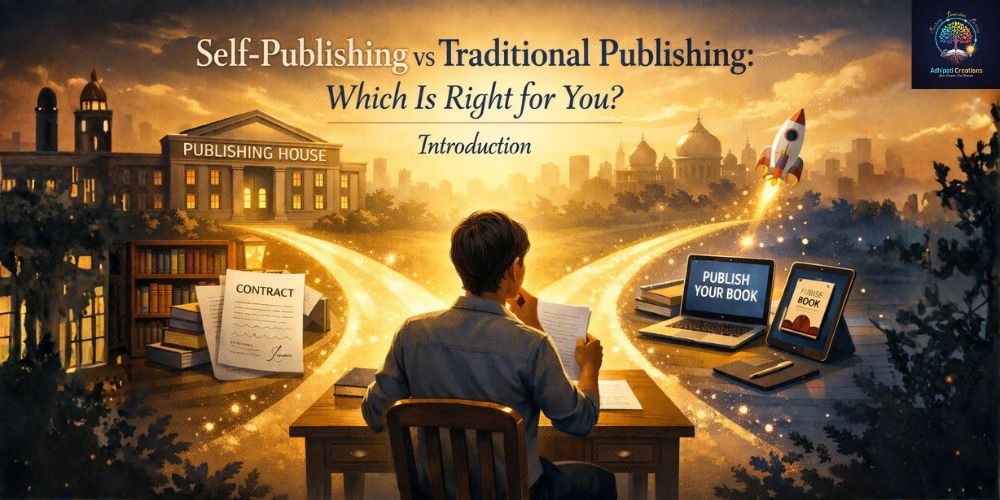
This brings us to the core debate that every modern author faces: self-publishing vs traditional publishing. In the past, there was only one way to become a "real" author—you had to be "picked" by a big publishing house. But times have changed. The rise of digital platforms and professional self-publishing services has leveled the playing field.
For Indian authors, this decision is especially important. Our market is unique, with diverse languages, a massive young population, and a rapidly growing interest in independent voices. Choosing the wrong publishing model can cost you time, money, and creative freedom. In this guide, we will break down everything you need to know to make the right choice for your literary career.
Table of Contents
Understanding the Two Publishing Models
What Is Traditional Publishing?
Traditional publishing is the "old school" method. In this model, an author writes a manuscript and tries to sell it to a publishing house (like Penguin, HarperCollins, or Rupa Publications).
In India, the process usually works like this:
- The Pitch: You send a proposal or the full manuscript to editors or literary agents.
- The Approval: If they like it, they offer you a contract. This process can take months or even years.
- The Investment: The publisher pays for the editing, cover design, printing, and some distribution. In some cases, established authors receive an "advance" (an upfront payment), though this is becoming rarer for debut Indian authors.
- The Catch: In exchange for taking the financial risk, the publisher keeps the lion's share of the profits. You receive a small royalty (usually 7.5% to 12% of the book's price). Most importantly, you lose control. The publisher decides the cover, the title, and when the book is released.
What Is Self-Publishing?
Self-publishing is the modern, democratic way to publish. Here, the author acts as the "CEO" of their book. You don't need anyone’s permission to publish. You own the rights, you keep the profits, and you decide the timeline.
With the help of professional self-publishing companies like Adhipati Creations, self-publishing has become a high-quality ecosystem. You aren't just "uploading a file"; you are working with experts to ensure your book looks and feels like a bestseller.
The main self-publishing benefits include:
- Speed: You can go from manuscript to market in weeks, not years.
- Ownership: You keep 100% of your rights.
- Profit: You earn much higher royalties per book sold.
The difference between self-publishing and traditional publishing really comes down to who holds the power. In traditional, the publisher holds the power. In self-publishing, you do.
Self-Publishing vs Traditional Publishing: Key Comparison
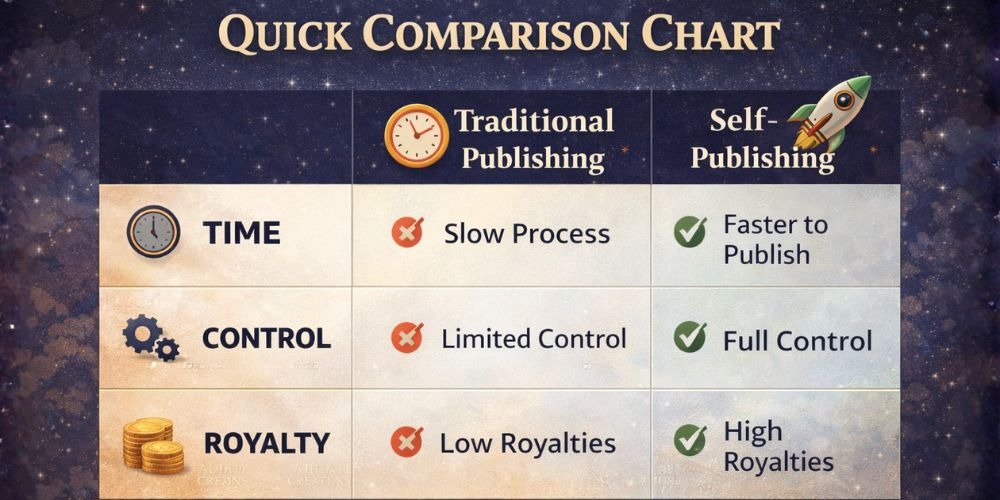
| Feature | Traditional Publishing | Self-Publishing |
|---|---|---|
| Time to Market | 12 to 24 months | 2 to 6 weeks |
| Creative Control | Publisher decides everything | Author has 100% control |
| Royalty/Earnings | Low (7% - 12%) | High (up to 70% - 100% of net) |
| Rights | You sell your rights to publisher | You retain all ownership |
| Distribution | Strong in physical bookstores | Strong online (Amazon/Flipkart) + Global |
| Initial Cost | Zero (but hard to get in) | Invest in professional services |
Royalty & Earnings
In India, a traditionally published book priced at ₹299 might earn the author only ₹20 to ₹30 per copy. You have to sell thousands of copies just to make a basic income. In self-publishing, because you aren't feeding a massive corporate machine, your margins are much higher. You can often earn 3x to 5x more per copy sold compared to traditional deals.
Creative Control
Have you ever seen a book with a cover that didn't match the story? That happens in traditional publishing because the marketing department, not the author, has the final say. Self-publishing allows you to choose your own book cover design, your own editor, and your own formatting style.
Time to Publish
Traditional publishers have "slots." They might only publish two thrillers a year. If their slots are full, your book sits on a shelf. Self-publishing allows you to strike while the iron is hot. If you write a book about a current trend today, it can be on Amazon by next month.
Challenges of Self-Publishing (and How to Solve Them)
Common Challenges
Self-publishing isn't magic; it’s a business. If you do it poorly, your book will look "amateur." Common issues include:
- Poor Editing: Typos and grammatical errors ruin your reputation.
- Weak Covers: People do judge a book by its cover.
- No Marketing: If no one knows your book exists, no one will buy it.
Professional Solutions with Adhipati Creations
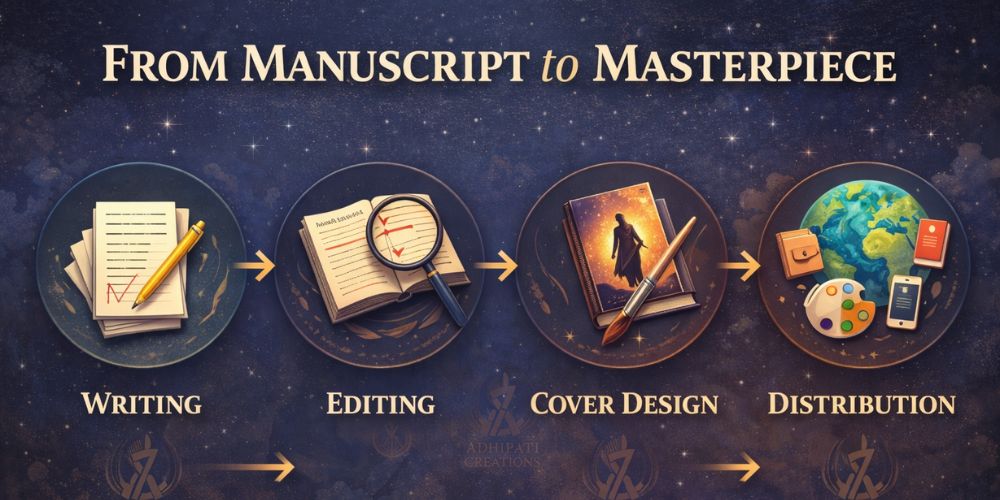
This is where a professional partner makes all the difference. You don't have to do it alone. Adhipati Creations provides the tools to ensure your self-published book looks exactly like a traditionally published one.
- Editing & Proofreading: Expert editors polish your manuscript so it’s error-free.
- Design & Formatting: Professional layouts that make reading a pleasure, both in print and on Kindle.
- ISBN & Distribution: They handle the legalities (ISBN) and make sure your book is available on major platforms.
- Marketing & Promotions Plan: They help you create a "buzz" so your book actually reaches the hands of readers.
- Pricing Strategy: Helping you set a price that is competitive in the Indian market while maximizing your profit.
Traditional Publishing in India: Who Is It Best For?
We aren't saying traditional publishing is "bad." It just serves a different purpose. It might be right for you if:
- You are already a celebrity or have a massive social media following (publishers love "guaranteed" sales).
- You are a literary writer aiming for prestigious awards that require traditional backing.
- You have no budget to invest upfront and are willing to wait 2 years to see your book in print.
However, for the average person with a great story or valuable knowledge, the barrier to entry for traditional publishing in India is incredibly high and often frustrating.
Which Publishing Model Is Right for You?
New & First-Time Authors
If you are asking which publishing is better for new authors, the answer is almost always self-publishing. Why? Because it allows you to build a "track record." If your self-published book sells 5,000 copies, traditional publishers will eventually come knocking at your door. It is the best way to learn the industry.
Experienced Authors
Many experienced authors are now moving toward "Hybrid Publishing." They might give their big novels to traditional publishers but self-publish their niche projects or novellas to keep a steady stream of income and control.
Authors Who Want Full Ownership
If you treat your book like your "baby" or a business asset, self-publishing is the clear winner. You don't want to sign away your rights for 70 years to a company that might stop caring about your book after the first month.
Self-Publishing with Adhipati Creations: A Smarter Way
Publishing a book should be an exciting journey, not a stressful one. Adhipati Creations acts as your personal publishing department. They offer end-to-end support, meaning they handle the technical "headaches" while you focus on what you do best: writing.
By choosing a professional partner, you get the best of both worlds: the quality of a traditional house with the freedom and profits of self-publishing. They understand the Indian market—what readers want, how they shop, and how to get your book noticed.
Final Verdict: Self-Publishing vs Traditional Publishing
The "old way" of publishing was about waiting for a chance. The "new way" is about taking that chance for yourself.
- Traditional publishing offers prestige but demands your time and your rights.
- Self-publishing offers freedom, speed, and better money, but it requires you to be proactive about quality.
In 2026, the walls are down. Don't let your manuscript sit in a drawer. Whether you choose the traditional path or the self-publishing route, the most important thing is to get your voice heard.
“The difference between self-publishing and traditional publishing really comes down to who holds the power. In traditional, the publisher holds the power. In self-publishing, you do.”
✅ Ready to turn your manuscript into a professional book?
Don't get lost in the confusion of the publishing world. Contact Adhipati Creations today for a free consultation. Let’s discuss your manuscript, your goals, and how we can help you become a published author with full pride and profit.