
One bad test.
One low score.
One disappointing result.
And suddenly it feels like everything you dreamed of is slipping away. The confidence you once had starts breaking. The books feel heavier. The mind feels tired. You wonder whether you are capable at all.
If you are feeling like this right now - stop, breathe, and read this carefully.
Failure does not define you. Your comeback does.
Every NEET rank holder, every JEE topper, every high scorer in CUET has faced failure at some point. They have cried, broken down, felt lost, and questioned themselves. But what made them extraordinary was not that they never failed - it was that they chose to stand up again.
If you are in that phase now then this blog is for you.
You are not alone.
You are not weak.
You are not done.
You are simply in the middle of your story and this is the part where strength is built.
Adhipati Creations stands with students during both highs and lows.
Our chapter-wise question banks, structured mock test series, and crash revision books are designed specifically to help students make strong comebacks - strategically and confidently.
Let us rebuild your momentum step by step.
Table of Contents
1️⃣ Accept the Failure, Don’t Deny It
The first step toward coming back stronger is not motivation - it is acceptance. When marks go low, most students react in one of three ways:
- They ignore the result and pretend it doesn't matter
- They panic and feel they are doomed
- They avoid studying because the score feels discouraging
But toppers?
They take a different approach.
They accept the result honestly.
Not emotionally.
Not personally.
Just logically.
Allow yourself to feel: It’s okay to feel:
- Sad
- Angry
- Frustrated
- Embarrassed
- Disappointed
These feelings show that your dream matters to you.
But remember:
You are not your marks.
One test does not define your future.
Your story doesn't end here.
“This marksheet is feedback not judgement.”
Treat every test like information, not evaluation. This is maturity. This is growth. This is how comebacks start.
2️⃣ Analyze What Actually Went Wrong
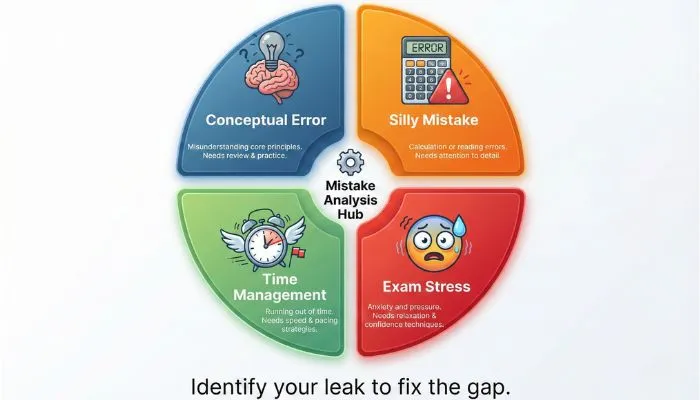
Once you accept the result, now comes the smart part — understanding why it happened.
Failure always has reasons.
And when you identify those reasons, you gain control.
Ask yourself:
| Question | Purpose |
|---|---|
| Did I study the concept fully? | Checks conceptual clarity |
| Did I revise enough? | Checks memory recall |
| Did I waste time during the test? | Checks time management |
| Did stress affect my performance? | Checks exam mindset |
This is where most students go wrong — They try to move on too quickly without learning from what went wrong. As a result, the same mistakes repeat.
Use This Method:
- Take your test paper
- Look at every wrong answer
- Categorize mistakes:
| Type of Mistake | Meaning | Solution |
|---|---|---|
| Conceptual | You didn’t understand the topic | Re-learn topic + do foundational MCQs |
| Silly/Calculation | You were careless or rushed | Slow down + double-check steps |
| Time Management | You spent too long on few questions | Learn skipping strategy |
| Stress/Easy Errors | Exam pressure interfered | Practice more mock environments |
Quote to Remember:
“Failure is not falling down - it’s refusing to get back up.”
You are already capable. You just need clarity not pressure.
3️⃣ Create a Comeback Plan
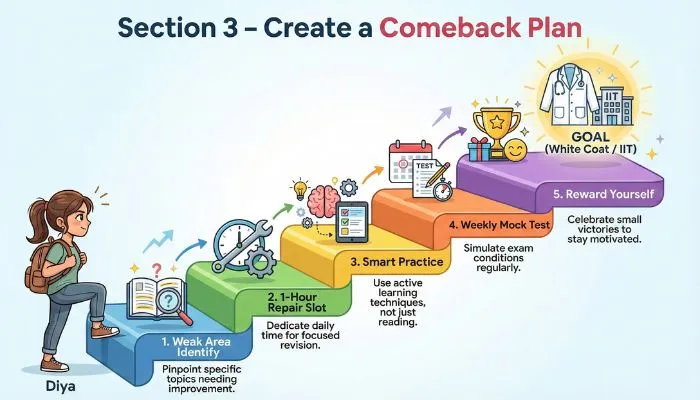
This is the part where you rebuild not the way you studied before, but in a smarter, structured, proven way.
Step-by-Step Comeback Strategy:
✅ Step 1: Identify Your Weak Areas
Choose 3 topics (not more) where you lost maximum marks. Examples:
- Biology: Human Physiology, Plant Kingdom
- Chemistry: Thermodynamics, Organic mechanisms
- Physics: Rotational Motion, Current Electricity
Trying to fix everything at once only leads to overwhelm.
✅ Step 2: Assign 1-Hour Repair Slots Daily
Every day, give one hour to each of your weak topics. Not 6 hours. Not all chapters. Just consistent corrections.
✅ Step 3: Practice Smart — Not Randomly
Use Adhipati Creations’ Chapterwise Question Banks to practice:
- Topic-wise MCQs
- Past year question patterns
- Concept-based explanations
This ensures progress is trackable.
✅ Step 4: 1 Mock Test Every Weekend
This is important. Mocks show:
- Progress
- Accuracy improvement
- Remaining weak points
✅ Step 5: Reward Effort — Not Score
If you studied honestly today → You succeeded today.
🟢 Call-to-Action: Start your comeback with Adhipati Creations Crash Revision Series — designed to rebuild confidence topic-by-topic.
4️⃣ Learn from Toppers Who Failed Before They Won
Here’s a truth many don’t know:
| Exam | Reality |
|---|---|
| NEET | Thousands scoring 650+ had once scored below 300 |
| JEE | Many 99 percentile rankers once scored 50–70 percentile |
| Boards | High scorers once failed unit tests |
Failure is a part of the journey not the end.
Example Story (Relatable & Realistic)
Aditi wanted to crack NEET 2026. Her first full mock score? 480. She felt broken, embarrassed, scared.
But instead of quitting, she:
- Analyzed every mistake
- Stopped using too many books
- Studied with Adhipati Creations Biology, Chemistry & Physics Series
- Practiced 1 mock test every 3 days
Six months later — she scored 680/720.
Not because she became a genius — but because she refused to quit.
🟢 Read the full story: How Aditi Transformed Her Score Using Adhipati Creations
5️⃣ Rebuild Your Daily Motivation
Motivation is not something you wait for — It is something you create daily.
Here’s how:
✅ Visualize Your Goal Every Morning
Close your eyes and imagine:
- Wearing that White Coat
- Sitting in that Engineering Lecture Hall
- Holding your Results Sheet with 95%+
This strengthens emotional drive.
✅ Limit Your Mental Inputs
Stop consuming:
- Over-advice
- Competitive comparison
- Negative self-talk
Focus on:
- Your journey
- Your chapter
- Your progress
✅ Study in 2-Hour Deep Focus Blocks
No phone. No multitasking. Just you and your goal.
✅ Surround Yourself with Supportive Study Material
Clean environment = calm mind = better study.
🟢 Internal Support: Use the Daily Motivation Planner
“Discipline is the bridge between failure and success.”
Motivation starts the journey. Discipline completes it.
6️⃣ The Role of the Right Study Material
Many students fail not because:
- They lack intelligence
- They lack effort
But because their study approach is disorganized.
The Right Study Material Helps You:
- Know what to study
- In what order
- With what practice questions
- And how to revise efficiently
This is what Adhipati Creations focuses on.
| Resource | Helps With |
|---|---|
| Chapterwise Question Banks | Build strong concepts gradually |
| Mock Test Packs | Improve speed & reduce fear |
| Crash Revision Series | Quick retention & confidence |
| Mistake Tracker Journals | Structured improvement |
Switch confusion to clarity - explore Adhipati Creations study materials.
7️⃣ Conclusion – Your Comeback Starts Now
Failure is not the end of your story.
It is the turning point.
You still have:
- Time
- Potential
- Strength
- Talent
- And support
What you need now is:
- Acceptance
- Reflection
- Discipline
- Smart planning
- Consistent effort
Take a deep breath.
Pick up your pen.
And continue your journey forward.
Because your story is not over - your comeback is just beginning.
Start Your Comeback Today:
🚀 Ready to Rewrite Your Story?
Don't let one bad test define you. Get the right tools and start your comeback today.